Ubiquiti Point-to-Point Wireless Solutions in Kenya
Buy Ubiquiti point-to-point wireless solutions in Kenya from Orbitlink Solutions for building-to-building links, CCTV, campuses, farms and network backhaul.
Top picks in Ubiquiti Point-to-Point Wireless Solutions in Kenya
Compare price points, specs, and bundles tailored to Kenyan homes and businesses.
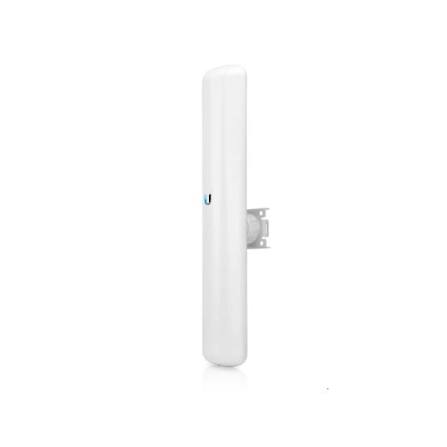
Ubiquiti Point-to-Point Wireless in Kenya – PtP Wireless Bridges & Long-Range Links
Ubiquiti point-to-point wireless (PtP) solutions provide a way to connect two physically separated locations without running Ethernet or fibre cable between them. A pair of outdoor directional radios creates a dedicated wireless bridge, allowing network traffic to travel between buildings, offices, warehouses, schools, farms, hotels, CCTV sites and other locations.
Ubiquiti currently maintains a broad UISP wireless portfolio covering airMAX, airFiber, Wave and other wireless platforms, with options across frequencies including 2.4 GHz, 5 GHz, 11 GHz, 24 GHz and 60 GHz. The appropriate technology depends on required distance, throughput, interference, line of sight, local frequency regulations and the purpose of the link.
A properly designed Ubiquiti PtP bridge behaves much like an invisible Ethernet cable between two sites. Internet access, VLANs, CCTV traffic, VoIP, local servers and other Ethernet services can potentially cross the wireless bridge, subject to the capabilities and configuration of the selected equipment.
What Is a Point-to-Point Wireless Link?
A point-to-point wireless link connects:
Location A
directly to:
Location B
using two compatible directional wireless devices.
A simplified installation looks like this:
Main Building
Router / Switch
↓
Ethernet Cable
↓
PoE Injector
↓
Ubiquiti PtP Radio A
))) Wireless Link (((
Ubiquiti PtP Radio B
↓
PoE Injector
↓
Switch / Access Point
↓
Remote Building
The two radios are carefully aligned toward one another to establish the wireless bridge.
This is different from ordinary Wi-Fi designed primarily to connect phones and laptops around a room. PtP equipment uses directional antennas and purpose-built wireless technologies to transport network traffic between fixed locations.
Ubiquiti Point-to-Point Wireless Technologies
Ubiquiti has several product families that can be used for point-to-point networking.
| Ubiquiti Family | Typical Role | Key Characteristic |
|---|---|---|
| airMAX | General PtP links | Cost-effective outdoor wireless |
| PowerBeam | Medium/long-distance PtP | Integrated directional dish |
| LiteBeam | Cost-effective long-range PtP | High-gain directional design |
| NanoBeam | Compact PtP links | Small directional enclosure |
| NanoStation | Short/medium-distance links | Compact versatile CPE |
| Rocket / PrismStation | PtP/PtMP infrastructure | External/high-gain antenna options |
| airFiber | High-capacity backhaul | Performance-focused PtP |
| Wave / 60 GHz | High-throughput links | Multi-gigabit-class wireless options |
Ubiquiti's current UISP catalogue includes airMAX 5 GHz and 2.4 GHz equipment, LTU products, dedicated airFiber PtP radios and 60 GHz Wave equipment.
How Ubiquiti Point-to-Point Wireless Works
The concept is straightforward.
Suppose a company has internet in:
Building A
but needs network connectivity in:
Building B
500 metres away.
Running fibre may require trenching, road crossings, permits or significant civil works.
Instead, two compatible Ubiquiti directional radios can be installed:
Internet
↓
Main Router
↓
Network Switch
↓
PtP Radio A
)))))))) Wireless Bridge ((((((((
PtP Radio B
↓
Remote Switch
↓
Computers / Wi-Fi / CCTV / Phones
The remote building can then use network resources delivered across the wireless bridge.
Ubiquiti PtP Is More Than an Internet Link
Point-to-point wireless is frequently described as a way to "send internet" from one building to another, but the underlying concept is broader.
The bridge can carry network traffic between two Ethernet networks.
Depending on configuration, this may include:
-
Internet traffic
-
CCTV video
-
VLAN traffic
-
VoIP
-
server access
-
NAS access
-
access-control traffic
-
Wi-Fi traffic
-
business applications
-
network management traffic
For example, a CCTV camera at a remote gate could transmit its video across a PtP link to an NVR located in the main building.
Ubiquiti PowerBeam for Point-to-Point Links
One of Ubiquiti's best-known PtP product families is the:
airMAX PowerBeam
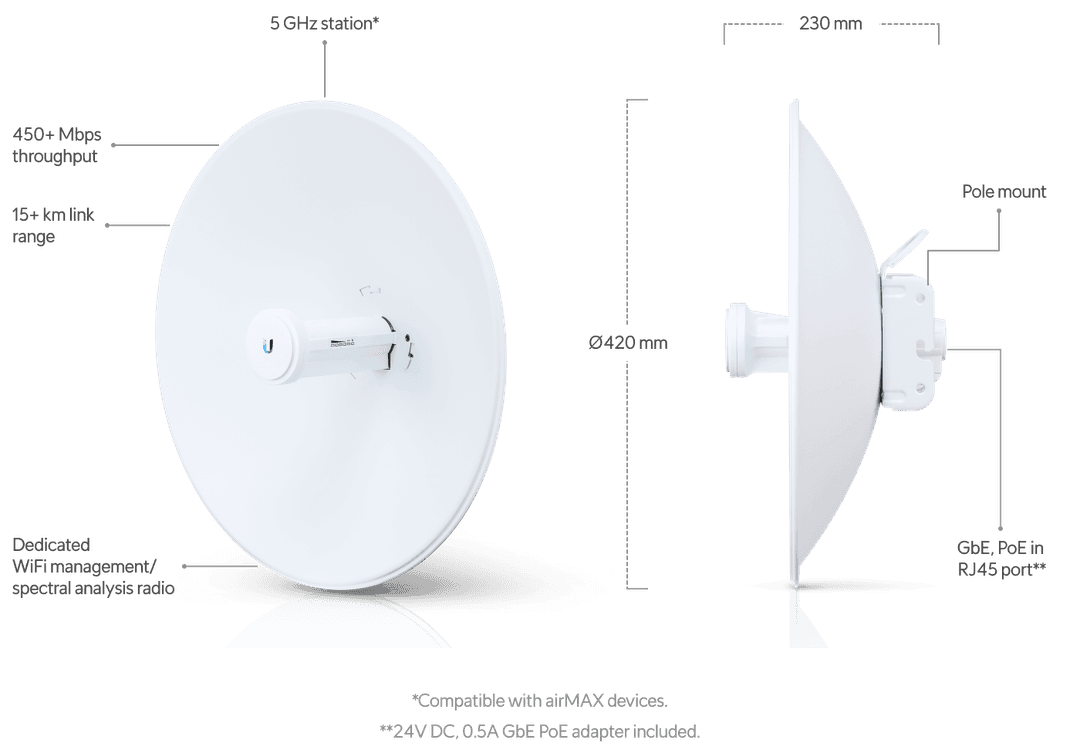
Ubiquiti currently describes the PowerBeam 5AC Gen2 as a high-performance 5 GHz Point-to-Point bridge with an integrated dish reflector.
The current PowerBeam 5AC Gen2 specification includes:
| Specification | PowerBeam 5AC Gen2 |
|---|---|
| Model | PBE-5AC-Gen2 |
| Frequency | 5 GHz |
| Ethernet | 1 × Gigabit RJ45 |
| Power | Passive PoE |
| Power Supply | 24V, 0.5A Gigabit PoE adapter |
| Maximum Consumption | 8.5W |
| Dimensions | 420 × 420 × 230 mm |
| Weight | 2.2 kg |
| Mounting | Pole |
| Wind Survivability | Up to 200 km/h |
Ubiquiti's current documentation confirms these hardware characteristics.
PowerBeam equipment is particularly useful where a focused directional link is needed between two fixed sites.
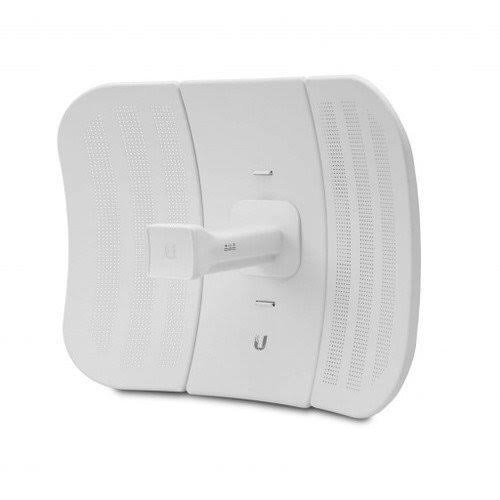
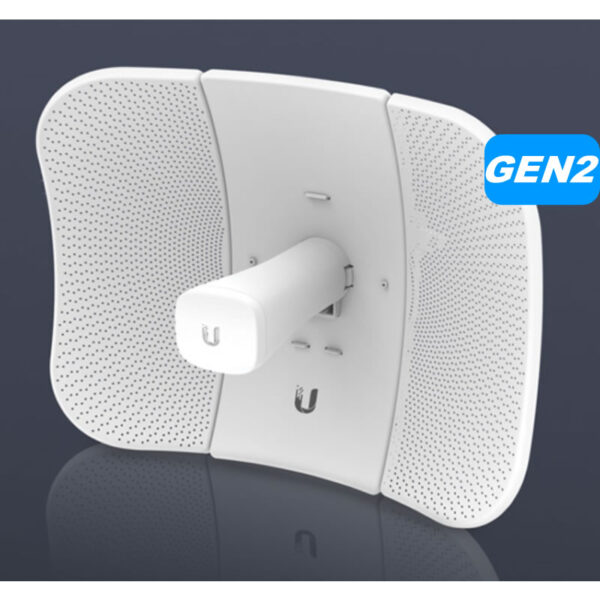
Ubiquiti LiteBeam 5AC for PtP Links
Another popular option is the:
Ubiquiti airMAX LiteBeam 5AC
The current LBE-5AC-GEN2 combines a 5 GHz directional antenna with a Gigabit Ethernet interface and airMAX AC technology. Ubiquiti specifies 23 dBi antenna gain and 450+ Mbps total throughput for the model.
LiteBeam 5AC Key Specifications
| Feature | Specification |
|---|---|
| Model | LBE-5AC-GEN2 |
| Frequency | 5 GHz |
| Antenna Gain | 23 dBi |
| Total Throughput | 450+ Mbps |
| Ethernet | 1 × Gigabit RJ45 |
| Power | Passive PoE |
| Adapter | 24V, 0.3A Gigabit PoE |
| Maximum Consumption | 7W |
| Operating Temperature | -40°C to 70°C |
| Wind Survivability | 200 km/h |
These are manufacturer specifications; actual link performance depends heavily on distance, channel conditions, interference, configuration and line of sight.
Ubiquiti NanoBeam 5AC for PtP Wireless
The NanoBeam 5AC Gen2 provides another compact option.
Unlike a large dish, the NanoBeam integrates the directional antenna into a relatively small enclosure.
Ubiquiti specifies the current NBE-5AC-GEN2 with two Gigabit Ethernet interfaces, passive PoE, a supplied 24V 0.5A Gigabit PoE adapter and maximum power consumption of 8.5W.
NanoBeam 5AC Key Features
| Feature | Specification |
|---|---|
| Model | NBE-5AC-GEN2 |
| Wireless Family | airMAX AC |
| Ethernet | 2 × GbE RJ45 |
| Power | Passive PoE |
| Included Adapter | 24V, 0.5A Gigabit PoE |
| Maximum Consumption | 8.5W |
| Dimensions | 189 × 189 × 125 mm |
| Weight | 530 g |
| Pole Mount | Included |
| Wall Mount | Optional |
| Operating Temperature | -40°C to 80°C |
Its compact form factor can make the NanoBeam attractive where visual impact or installation space matters.
Ubiquiti airFiber for High-Capacity PtP Backhaul
For networks requiring substantially higher backhaul performance, Ubiquiti offers:
airFiber
Unlike ordinary Wi-Fi access equipment, airFiber products are specifically positioned toward high-performance point-to-point backhaul.
For example, Ubiquiti describes the airFiber 5XHD as providing 1+ Gbps PtP technology designed for WISP applications.
The current airFiber portfolio also includes equipment operating across different frequency bands and performance classes. Ubiquiti lists products such as the AF-5XHD, AF-24 and AF-24HD alongside 11 GHz options.
Ubiquiti airFiber 5XHD
The AF-5XHD is a high-performance 5 GHz PtP radio intended for demanding wireless backhaul applications.
Ubiquiti describes it as:
1+ Gbps-class, spectrally efficient, noise-resilient PtP technology.
The radio provides:
2 × Gigabit Ethernet interfaces
and supports passive PoE powering.
Ubiquiti supplies a 24V, 1A Gigabit PoE adapter with the current product.
Unlike integrated PowerBeam or LiteBeam devices, airFiber X radios can form part of a modular radio-and-antenna system.
Ubiquiti 60 GHz Point-to-Point Wireless

Ubiquiti also offers:
60 GHz wireless
for very high-throughput PtP and PtMP networks.
The current Wave/60 GHz portfolio includes products such as:
Wave Pro
Wave Nano
Wave Long-Range
and:
airFiber 60 Long-Range.
Ubiquiti describes the Wave Pro as a high-capacity 60 GHz radio supporting long-distance PtP and PtMP links, while the current Wave AP Gen2 is specified for 2.7 Gbps symmetrical speed in its supported multipoint architecture.
5 GHz vs 60 GHz Ubiquiti PtP
Choosing the frequency is an important part of designing a wireless bridge.
| Consideration | 5 GHz PtP | 60 GHz PtP |
|---|---|---|
| Typical equipment | PowerBeam, LiteBeam, NanoBeam, airFiber 5XHD | Wave, airFiber 60 |
| Long-distance options | Strong | More distance-sensitive |
| Throughput potential | High | Very high |
| Interference | Can be significant | Usually more isolated |
| Weather sensitivity | Generally lower | Higher, especially rain at long distances |
| Alignment | Important | Very important |
| Clear line of sight | Strongly recommended | Critical |
| Typical use | General backhaul | High-capacity links |
This is a broad planning comparison rather than a substitute for checking the exact radio pair, permitted frequencies and link conditions.
2.4 GHz Ubiquiti PtP
Ubiquiti also continues to list 2.4 GHz airMAX equipment, including products such as NanoBeam 2AC and PowerBeam 2AC.
The 2.4 GHz band can sometimes be useful where its propagation characteristics are advantageous.
However, it is also widely used by conventional Wi-Fi and many other wireless systems, meaning interference can be significant in populated environments.
Frequency selection should therefore follow a proper site survey rather than assuming that one band is universally better.
Line of Sight Is Critical
A PtP wireless bridge works best when the two antennas have a:
Clear line of sight
That means Radio A should have a clear path toward Radio B.
Obstructions can include:
buildings
trees
hills
billboards
water tanks
rooftop structures
and other physical obstacles.
Simply being able to see the general direction of the remote site from ground level does not necessarily mean the radio path is suitable.
Fresnel Zone
Point-to-point design also involves the:
Fresnel zone
A radio link needs more than a thin visual line between the two antennas.
Radio energy occupies an area around the direct path.
An obstacle may therefore interfere with the link even when it does not completely block the visual line between the antennas.
This is why longer links often require antennas to be installed higher than might initially seem necessary.
Why Antenna Height Matters
Consider:
Building A
↓
Tree line
↓
Building B
Even if the roofs can barely see each other, the trees may intrude into the radio path.
Installing the antennas higher can improve:
line of sight
Fresnel-zone clearance
and ultimately:
link reliability.
However, mounting height should also account for structural stability, wind loading, lightning protection, cable length and safe access for maintenance.
Distance Is Not the Only Factor
A common question is:
"How many kilometres can Ubiquiti point-to-point reach?"
There is no single correct distance for the entire Ubiquiti range.
Link capability depends on:
-
radio model
-
antenna gain
-
frequency
-
channel width
-
permitted transmit power
-
antenna height
-
line of sight
-
Fresnel clearance
-
interference
-
weather
-
required throughput
-
local regulations
A low-capacity link may remain usable at a distance where a high-throughput link cannot achieve its intended performance.
Ubiquiti Point-to-Point for Building-to-Building Internet
One of the most common applications is extending internet from one building to another.
For example:
Main Office
Fibre / Starlink
↓
Router
↓
Switch
↓
Ubiquiti PtP Radio A
)))))))) Wireless Link ((((((((
Ubiquiti PtP Radio B
↓
Switch
↓
Access Points
↓
Remote Office
The remote office can then use the internet connection from the main site.
Ubiquiti Point-to-Point for CCTV
PtP wireless is also extremely useful where cameras are located far from the main NVR.
For example:
Remote Gate
CCTV Cameras
↓
PoE Switch
↓
PtP Radio B
)))))))) Wireless Link ((((((((
PtP Radio A
↓
Main Switch
↓
NVR
This can eliminate the need to trench fibre or Ethernet between the gate and the main building.
Ubiquiti PtP for Farms
Large farms often have buildings separated by considerable distances.
A PtP bridge can potentially connect:
main house
farm office
store
workers' accommodation
gatehouse
CCTV towers
and other remote structures.
A combination of point-to-point and point-to-multipoint links may be appropriate where several remote sites need connectivity.
Ubiquiti PtP for Schools
A school campus could use PtP wireless to connect:
Administration Block
to:
Classroom Block
or:
Library
Laboratory
Dormitory
Gatehouse
Staff quarters
and other separated buildings.
Each remote location can then have a network switch and Wi-Fi access points.
Ubiquiti PtP for Hotels and Resorts
Hotels and resorts frequently contain physically separated structures.
PtP links can be considered for:
main hotel buildings
conference areas
cottages
restaurants
security gates
staff accommodation
and:
remote CCTV installations.
This can be particularly useful where trenching new fibre would disrupt landscaped grounds or paved areas.
Ubiquiti PtP for Warehouses
Suppose a company has:
Warehouse A
and:
Warehouse B
on opposite sides of a compound.
A PtP bridge can connect their LANs without running copper cable outdoors between the buildings.
The remote warehouse can then use:
Wi-Fi
computers
CCTV
barcode scanners
printers
and:
VoIP
through the main network.
Ubiquiti PtP for Construction Sites
Temporary and semi-permanent construction projects can also benefit from wireless backhaul.
Connectivity can be extended between:
site office
security gate
stores
workers' areas
and other project locations.
Wireless can be particularly attractive when digging trenches for temporary fibre infrastructure is impractical.
Ubiquiti PtP for Starlink
A useful application in Kenya is distributing a Starlink connection from one building to another.
For example:
Building A
Starlink
↓
Router
↓
Switch
↓
PowerBeam / LiteBeam
)))))))) PtP Link ((((((((
PowerBeam / LiteBeam
↓
Switch
↓
Access Points
↓
Building B
The point-to-point equipment does not increase Starlink's bandwidth.
It simply transports the network connection between the two locations.
Ubiquiti PtP for Fibre Internet
The same architecture works with fibre:
Fibre ONT
↓
Router / Firewall
↓
Switch
↓
PtP Radio A
)))))))) Wireless Bridge ((((((((
PtP Radio B
↓
Remote Network
The internet provider therefore does not need to be Ubiquiti.
Using Ubiquiti PtP with MikroTik
Ubiquiti wireless bridges can operate as part of a network using MikroTik routing equipment.
For example:
Internet
↓
MikroTik Router
↓
Ubiquiti PtP Radio
)))))))) Wireless Link ((((((((
Ubiquiti PtP Radio
↓
MikroTik / Ubiquiti / TP-Link Switch
The router and wireless bridge perform different functions.
Using Ubiquiti PtP with TP-Link
Similarly, the LAN can contain TP-Link equipment.
For example:
TP-Link Router
↓
Ubiquiti PowerBeam
)))))))) PtP ((((((((
Ubiquiti PowerBeam
↓
TP-Link Switch
↓
Access Points / Computers
There is no requirement that every component of the network be from the same manufacturer.
Point-to-Point vs Point-to-Multipoint
These two concepts should not be confused.
Point-to-Point – PtP
Site A ↔ Site B
One wireless link connects two locations.
Point-to-Multipoint – PtMP
One base station connects to several remote stations:
Base Station
↙ ↓ ↘
Site A – Site B – Site C
Ubiquiti offers equipment capable of both architectures. Its current wireless portfolio explicitly includes products designed for PtP and PtMP roles.
PtP vs Wi-Fi Range Extender
A point-to-point bridge should not be confused with an ordinary Wi-Fi extender.
A Wi-Fi extender generally attempts to improve client coverage around a building.
A PtP bridge is designed to:
transport a network between two fixed locations.
For building-to-building connectivity, properly installed directional PtP equipment is usually a fundamentally different architecture from placing an indoor Wi-Fi repeater near a window.
Ubiquiti PtP vs Fibre Optic Cable
Both technologies can connect separate buildings.
| Feature | Ubiquiti PtP Wireless | Fibre Optic Cable |
|---|---|---|
| Trenching | Usually unnecessary | Often required |
| Deployment speed | Often faster | Can require civil works |
| Physical cable between sites | No | Yes |
| Line of sight | Required/important | Not required |
| Wireless interference | Possible | No RF interference |
| Weather effects | Possible | Minimal on optical link |
| Very high capacity | Model-dependent | Excellent |
| Physical route required | No cable route | Yes |
| Maintenance | Radio alignment/equipment | Fibre/civil infrastructure |
Neither technology is universally superior.
Fibre is often preferable where maximum reliability, capacity and long-term infrastructure justify installation.
PtP wireless can be extremely valuable where fibre installation would be expensive, slow or physically difficult.
Ubiquiti PtP vs Ethernet Cable
Standard copper Ethernet is subject to practical distance limitations and should not simply be stretched across long outdoor building-to-building routes.
For separated buildings, professionally designed:
fibre
or:
wireless PtP
is generally a more appropriate architecture.
Fibre also avoids electrical potential differences between buildings because the optical medium is non-conductive.
Choosing the Right Ubiquiti Point-to-Point Device
The correct model depends on the project rather than simply choosing the device advertised with the greatest range.
Important questions include:
-
What is the distance?
-
Is there clear line of sight?
-
What throughput is required?
-
How congested is the RF environment?
-
Is this internet, CCTV or network backhaul?
-
What mounting height is available?
-
What frequency can legally be used?
-
Is the link temporary or permanent?
-
How much future capacity is needed?
-
What is the project budget?
These factors should be considered together.
Short-Distance Ubiquiti PtP Links
For shorter links, compact devices such as NanoBeam or appropriate NanoStation models can be attractive.
The benefit is not simply distance.
Compact radios can provide:
smaller mounting footprint
lower visual impact
and:
simpler installation
while still providing directional wireless connectivity.
The exact radio should still be selected according to the link budget and RF environment.
Medium-Distance Ubiquiti PtP Links
PowerBeam and LiteBeam models are commonly considered where greater directional gain is useful.
The current LiteBeam 5AC, for example, provides a 23 dBi antenna, while the PowerBeam uses an integrated dish reflector intended specifically for directional PtP operation.
The correct model depends on the required link performance rather than distance alone.
Long-Distance Ubiquiti PtP Links
Long-distance wireless links require much more careful planning.
The design should consider:
Earth curvature for sufficiently long paths
Fresnel clearance
antenna height
tower stability
interference
antenna gain
frequency
weather
and:
required availability.
For demanding backhaul applications, Ubiquiti's airFiber family provides dedicated high-performance PtP products.
Weather and Ubiquiti PtP Links
Outdoor wireless systems operate in real weather conditions.
Installers should consider:
rain
wind
temperature
lightning
humidity
and:
corrosion.
For example, Ubiquiti specifies the current PowerBeam 5AC Gen2 for operation from -40°C to 70°C and wind survivability up to 200 km/h.
These manufacturer ratings do not eliminate the need for structurally appropriate mounting and proper outdoor installation practices.
Lightning and Surge Protection
Outdoor radios are exposed to electrical surges and lightning-related events.
A professional installation should therefore consider:
shielded outdoor Ethernet cable
proper grounding
surge protection
and:
correct building-entry practices.
A PoE injector alone should not be treated as a complete lightning-protection system.
Important PoE Compatibility Note
Many Ubiquiti airMAX radios use:
24V passive PoE
rather than ordinary IEEE 802.3af/at PoE.
For example, the current PowerBeam 5AC Gen2 uses 24V passive PoE, and Ubiquiti supplies a compatible 24V 0.5A Gigabit PoE adapter.
The LiteBeam 5AC likewise uses passive PoE and ships with a 24V adapter.
Therefore, installers should not assume that every ordinary PoE switch can directly power every airMAX radio.
Always verify the exact radio's required voltage and PoE method.
Outdoor Ethernet Cabling
The cable connecting an indoor network to an outdoor radio is an important part of the installation.
For permanent installations, use cable appropriate for:
outdoor exposure
UV exposure
PoE
and the installation environment.
Poor-quality outdoor cable can undermine an otherwise well-designed wireless link.
Alignment Matters
Directional antennas need accurate alignment.
A rough installation pointed "approximately" toward the remote building may establish a connection, but that does not mean the link is optimized.
Proper alignment can improve:
signal strength
signal-to-noise ratio
modulation
throughput
and:
link stability.
The narrower the antenna beam, the more precise alignment generally becomes.
Wireless Interference
A clear visual path does not guarantee excellent performance.
A 5 GHz link may still encounter interference from:
nearby wireless networks
WISPs
other PtP links
and:
local RF systems.
Channel planning and spectrum analysis are therefore important, particularly in dense urban environments.
Ubiquiti Point-to-Point Wireless Advantages

A well-designed Ubiquiti PtP network can provide several practical advantages.
It can avoid expensive trenching and civil works, particularly where roads, paved areas, landscaped compounds or rented property separate the two locations.
Deployment can also be relatively quick once a suitable line of sight and mounting locations have been confirmed.
Ubiquiti offers a particularly broad product range, from economical airMAX radios through high-capacity airFiber and Wave solutions, allowing different links to be designed around different capacity and distance requirements.
Limitations of Ubiquiti Point-to-Point Wireless
Wireless PtP is not appropriate for every project.
Obstructed line of sight can make a proposed link unreliable or impossible without taller mounting infrastructure.
Interference can also reduce performance in congested unlicensed spectrum.
Higher-frequency systems such as 60 GHz can deliver substantial capacity but require particularly careful path planning and can be more affected by atmospheric conditions.
For mission-critical links, redundancy, fibre backup or alternative paths may need to be considered.
Site Survey Before Installation
For professional installations, a site survey is highly recommended.
A survey can assess:
GPS coordinates
distance
line of sight
mounting locations
antenna heights
obstructions
Fresnel clearance
RF conditions
power availability
cable routes
and:
required throughput.
This information helps determine whether a proposed link is realistic before purchasing equipment.
Ubiquiti Point-to-Point Wireless Price in Kenya
There is no single Ubiquiti point-to-point wireless price because this is a category containing many different products and architectures.
A basic airMAX link may use two relatively economical radios, while a high-capacity airFiber or Wave deployment can involve significantly more specialized equipment.
The total project cost can also include:
two radios
mounting hardware
PoE equipment
outdoor Ethernet cable
surge protection
poles or masts
network switches
installation
alignment
and:
site survey work.
Contact Orbitlink Solutions for current Ubiquiti point-to-point wireless prices and stock availability in Kenya.
Why Buy Ubiquiti Point-to-Point Wireless from Orbitlink Solutions?
Selecting PtP equipment should begin with the link requirement, not simply the product name. A short office-to-warehouse connection, a 5 km CCTV backhaul and a high-capacity ISP backbone have very different technical requirements even though all three can be described as point-to-point wireless.
Distance also needs to be considered together with throughput. A radio being capable of establishing a link over a particular distance does not mean it will provide the customer's desired throughput at that distance. Frequency, antenna gain, interference, channel width, regulatory limits and Fresnel-zone clearance all affect real-world performance.
Orbitlink Solutions can help customers select suitable Ubiquiti radios and supporting networking equipment for building-to-building internet, CCTV backhaul, office links, school campuses, farms, hotels, warehouses and other outdoor wireless projects.
Watch the Ubiquiti Point-to-Point Wireless Video
A Ubiquiti point-to-point link should be viewed as network infrastructure rather than simply long-range Wi-Fi. The purpose is normally to create a reliable data path between two fixed locations. Once that path is established, the remote location can have its own switch, access points, cameras, computers and other network devices just as though it were connected through a physical cable.
The most important factor is therefore not the advertised maximum range of an individual radio. A successful link combines the correct radio, antenna characteristics, frequency, mounting height, clear line of sight, Fresnel-zone clearance and suitable RF conditions. Two properly selected and aligned radios can provide a much better result than more expensive equipment installed without proper planning.
It is also worth designing for future requirements. A customer who needs only 50 Mbps today may later add CCTV cameras, additional users, cloud backups or more Wi-Fi access points. Where expansion is expected, specifying additional wireless capacity at the beginning can reduce the need to replace the bridge later.
Frequently Asked Questions About Ubiquiti Point-to-Point Wireless
What is Ubiquiti point-to-point wireless?
It is a wireless network architecture that uses compatible directional radios to create a dedicated link between two fixed locations.
Do I need two Ubiquiti devices for a point-to-point link?
Generally, yes. A basic PtP bridge has one compatible radio at each end of the link.
Can Ubiquiti point-to-point send internet to another building?
Yes. A PtP bridge can transport network traffic from a building with internet access to a remote building.
Can I use Ubiquiti PtP for CCTV?
Yes. CCTV is a common application, especially where cameras or remote PoE switches are located far from the main NVR.
Can I use it with Starlink?
Yes. A PtP bridge can extend the LAN downstream of a Starlink connection to another location. It does not increase Starlink's available bandwidth.
Can I use Ubiquiti PtP with fibre internet?
Yes. The upstream internet technology can be fibre, Starlink, fixed wireless or another connection.
Can I use MikroTik routers with Ubiquiti PtP radios?
Yes. Ubiquiti radios can form the wireless bridge while MikroTik handles routing and firewall functions.
Can I use TP-Link switches with Ubiquiti PtP?
Yes, provided normal Ethernet and network configuration requirements are satisfied.
Does Ubiquiti point-to-point require line of sight?
A clear line of sight is highly important, especially for high-performance and longer-distance links. Fresnel-zone clearance should also be considered.
Can trees affect a point-to-point link?
Yes. Trees can obstruct the path and interfere with the Fresnel zone. Seasonal growth and wet foliage can also change link conditions.
Can buildings affect the wireless link?
Yes. Buildings and other structures can obstruct or reflect radio signals.
How far can Ubiquiti point-to-point wireless reach?
There is no single range covering all Ubiquiti PtP equipment. Range depends on the exact radios, antennas, frequency, mounting height, line of sight, interference, regulatory limits and required throughput.
Is PowerBeam good for point-to-point links?
Yes. Ubiquiti specifically describes the PowerBeam 5AC as a high-performance 5 GHz PtP bridge with an integrated dish reflector.
Is LiteBeam suitable for point-to-point?
Yes. The current LiteBeam 5AC supports airMAX AC operation, has a 23 dBi antenna and is rated by Ubiquiti for 450+ Mbps total throughput.
Is NanoBeam suitable for PtP?
Yes. NanoBeam models are commonly used as compact directional wireless devices for PtP applications.
What is airFiber?
airFiber is Ubiquiti's performance-oriented wireless backhaul family. The current portfolio includes dedicated PtP products across several frequency bands.
Can Ubiquiti PtP provide Gigabit speeds?
Some higher-performance Ubiquiti platforms can provide gigabit-class throughput. For example, Ubiquiti describes the airFiber 5XHD as a 1+ Gbps PtP solution.
Actual throughput depends on the complete link design and operating conditions.
Does Ubiquiti have 60 GHz point-to-point equipment?
Yes. Ubiquiti currently offers Wave and airFiber 60 GHz equipment supporting PtP applications.
Is 5 GHz or 60 GHz better?
Neither is universally better. 5 GHz can be useful for flexible and longer-distance deployments, while 60 GHz can provide very high throughput where path conditions and distance are suitable.
Is PtP better than fibre?
It depends on the project. Fibre provides excellent capacity and immunity to RF interference, while PtP wireless can avoid trenching and may be faster or less expensive to deploy where installing fibre is difficult.
Can a PtP link carry VLANs?
Yes, appropriately configured wireless bridges can transport VLAN traffic. The exact design depends on the radios and network configuration.
Can a PtP link connect two switches?
Yes. This is one of the common architectures: a switch at one site connects through the wireless bridge to a switch at the remote site.
Can I connect an access point at the remote end?
Yes. A remote switch or appropriate Ethernet connection can feed Wi-Fi access points at the second location.
Does a Ubiquiti PtP radio provide Wi-Fi for phones?
A PtP bridge's primary purpose is fixed-site backhaul. For client Wi-Fi coverage at the remote site, installing a dedicated access point is generally the appropriate architecture.
Do PowerBeam and LiteBeam use normal PoE?
Many airMAX products use passive PoE, not standard IEEE 802.3af/at. For example, Ubiquiti specifies 24V passive PoE for the current PowerBeam 5AC and LiteBeam 5AC.
Do I need a PoE injector?
Many models include a suitable PoE adapter, but this varies by product and package. Always check the exact model and current package contents.
Does antenna alignment matter?
Yes. Proper alignment is essential for maximizing signal quality and link performance.
Should I carry out a site survey?
For professional links, especially longer or business-critical installations, a site survey is strongly recommended.
What is the Ubiquiti point-to-point wireless price in Kenya?
Pricing depends on the exact radios, distance, required throughput and installation accessories. Contact Orbitlink Solutions for current pricing and stock availability.
Buy Ubiquiti Point-to-Point Wireless in Kenya
Ubiquiti offers one of the broadest wireless-backhaul ranges, from economical airMAX LiteBeam, NanoBeam and PowerBeam equipment to high-performance airFiber and Wave solutions. Its current UISP portfolio covers numerous frequencies, antenna configurations and performance classes for PtP and PtMP deployments.
The correct system should be selected after considering distance, line of sight, Fresnel clearance, throughput, frequency, interference, antenna height and future network growth. For longer or business-critical links, proper site assessment and professional alignment can be just as important as choosing the radio itself.
Contact Orbitlink Solutions
Orbitlink Solutions
Lyric House, 7th Floor, Room S9, Kimathi Street, Nairobi
Call / Text / WhatsApp: +254 743 720 551
Email: info@orbitlinksolutions.co.ke
Alternative Email: orbitlinksolutions@gmail.com
Opening Hours: Monday–Saturday, 9:00 AM–6:00 PM
Availability: Nairobi pickup and nationwide delivery
Contact Orbitlink Solutions for the current Ubiquiti point-to-point wireless prices in Kenya, stock availability, site-survey guidance and assistance selecting PowerBeam, LiteBeam, NanoBeam, airFiber, Wave and supporting networking equipment for your project.