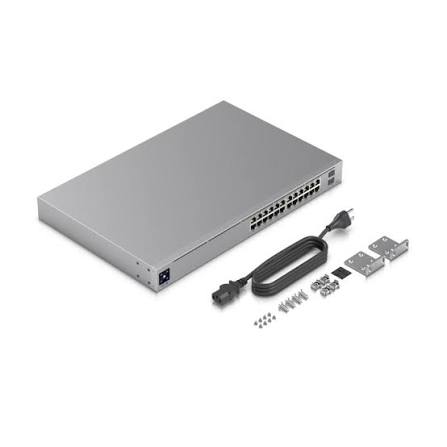
Ubiquiti USW-Pro-24-PoE
Buy Ubiquiti USW-Pro-24-PoE in Kenya from Orbitlink Solutions. 24-port Layer 3 UniFi switch with 400W PoE, PoE++, dual 10G SFP+ and RPS support.
Ubiquiti UniFi USW-Pro-24-PoE in Kenya – 24-Port Layer 3 PoE++ Managed Switch
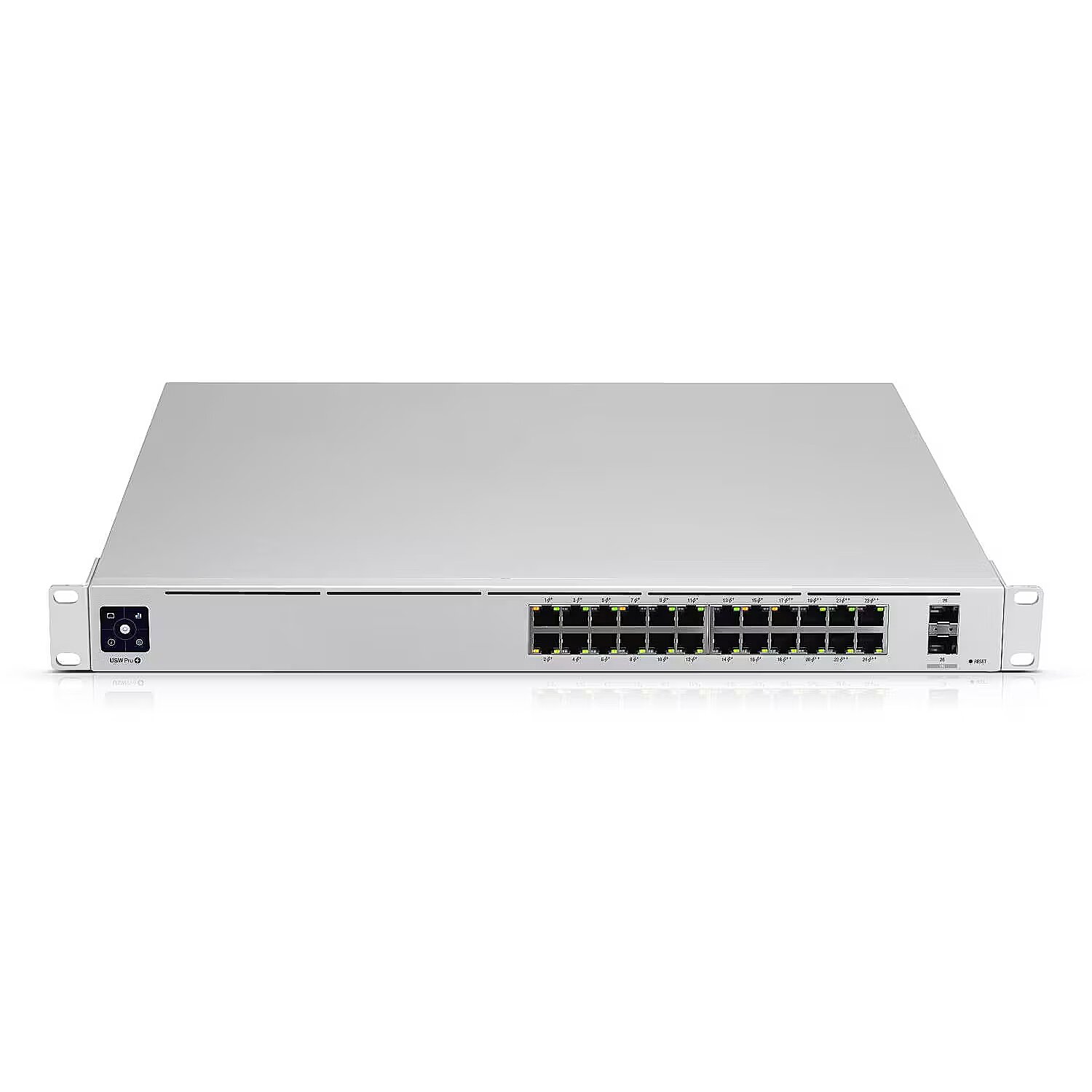
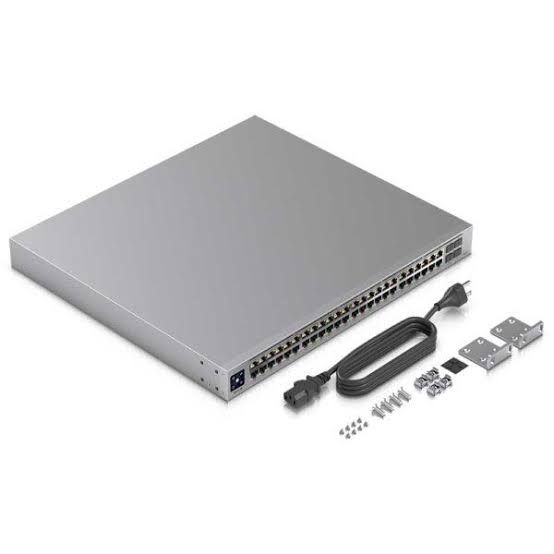
The Ubiquiti UniFi USW-Pro-24-PoE, officially called the Pro 24 PoE, is a professional 24-port managed Layer 3 switch designed for business, enterprise, hospitality, surveillance, Wi-Fi and other demanding network deployments. It combines 24 Gigabit Ethernet ports, high-power PoE++, two 10G SFP+ uplinks and a substantial 400W PoE budget in a 1U rack-mountable chassis.
Unlike the standard USW-24-PoE, every one of the 24 RJ45 ports on the Pro model can supply PoE: 16 ports support PoE+ and eight support higher-power PoE++. This makes the switch suitable for networks containing a mixture of UniFi access points, IP cameras, VoIP phones, access-control equipment and other compatible powered devices.
The USW-Pro-24-PoE also provides Layer 3 switching, 10Gbps SFP+ uplinks and UniFi SmartPower Redundant Power System compatibility, making it a significant step above Ubiquiti's Standard 24 PoE for larger and more critical installations.
Ubiquiti USW-Pro-24-PoE Key Features
| Feature | Specification |
|---|---|
| Product Name | UniFi Pro 24 PoE |
| Model | USW-Pro-24-PoE |
| Switch Type | Managed Layer 3 PoE Switch |
| RJ45 Ports | 24 × 10/100/1000 Mbps |
| PoE+ Ports | 16 |
| PoE++ Ports | 8 |
| Total Powered RJ45 Ports | 24 |
| SFP+ Ports | 2 × 1/10Gbps |
| Maximum PoE Class | PoE++ |
| Total PoE Availability | 400W |
| PoE per Port | 15.4W PoE / 30W PoE+ / 60W PoE++ |
| Switching Capacity | 88Gbps |
| Non-Blocking Throughput | 44Gbps |
| Forwarding Rate | 65 Mpps |
| Layer 3 | Yes |
| VLANs | Up to 1,000 |
| MAC Address Table | 16,000 |
| Redundant Power | USP-RPS DC input |
| Display | 1.3-inch touchscreen |
| Power Supply | Internal 450W AC/DC |
| Rack Size | 1U |
| Management | UniFi Network |
These specifications are from Ubiquiti's current technical documentation for the USW-Pro-24-PoE.
24 Gigabit Ethernet Ports
The USW-Pro-24-PoE provides:
24 × 10/100/1000 Mbps RJ45 ports.
All 24 ports can therefore provide Gigabit Ethernet connectivity.
A typical deployment might use:
USW-Pro-24-PoE
├── UniFi Access Point
├── UniFi Access Point
├── UniFi Access Point
├── IP Camera
├── IP Camera
├── VoIP Phone
├── Access-Control Device
├── Server / NAS
└── Other Ethernet Devices
This makes the switch suitable for centralized network distribution in medium and larger installations.
All 24 RJ45 Ports Support PoE
One major difference between the USW-Pro-24-PoE and Ubiquiti's lower-cost Standard 24 PoE is that all 24 RJ45 ports on the Pro model are PoE capable.
They are divided into:
16 × Gigabit PoE+ ports
and:
8 × Gigabit PoE++ ports.
This provides considerably greater flexibility when the network contains many powered devices.
16 PoE+ Ports
Sixteen RJ45 ports support PoE+.
Ubiquiti specifies maximum PSE output of:
PoE – 15.4W
PoE+ – 30W per compatible port.
These ports can be appropriate for many compatible:
-
UniFi access points
-
IP cameras
-
VoIP phones
-
wireless bridges
-
IoT devices
-
network controllers
The exact powered-device specification should always be checked.
8 High-Power PoE++ Ports
The other eight RJ45 ports support PoE++.
Ubiquiti specifies maximum PSE output of:
60W per PoE++ port.
PoE++ is useful when a powered device requires more energy than ordinary PoE+ can provide.
Examples can include compatible high-power:
Access points
PTZ cameras
access-control systems
PoE-powered switches
and other higher-consumption Ethernet devices.
The presence of eight PoE++ ports makes the USW-Pro-24-PoE substantially more flexible than a PoE+-only switch.
400W Total PoE Budget
One of the strongest features of the USW-Pro-24-PoE is its:
400W Total PoE Availability
Ubiquiti's current specification confirms a 400W PoE budget.
This is important because the number of PoE ports alone does not tell you how many devices the switch can power simultaneously.
The total power consumption of all connected devices must remain within the switch's available PoE budget.
Example PoE Budget Calculation
Consider an installation containing:
| Equipment | Quantity | Max Consumption | Combined |
|---|---|---|---|
| Access Points | 8 | 21W | 168W |
| Cameras | 8 | 10W | 80W |
| VoIP Phones | 4 | 7W | 28W |
| Access Devices | 2 | 20W | 40W |
| Total | 22 devices | 316W |
A 400W switch provides enough theoretical budget for this 316W maximum-load example, with additional headroom.
Actual equipment should always be calculated using the manufacturer's published maximum power requirements.
PoE Budget vs Per-Port Power
There are two separate limits to consider:
Per-Port Limit
A PoE++ port can provide up to 60W PSE output.
Total Switch Limit
All connected PoE devices share the switch's 400W total PoE availability.
For example, eight PoE++ ports theoretically capable of 60W each would equal:
8 × 60W = 480W
But the switch's total PoE availability is 400W, and other PoE+ ports may also be consuming power.
Therefore, per-port capability and total budget must both be considered.
Two 10G SFP+ Uplink Ports
The USW-Pro-24-PoE provides:
2 × 1/10Gbps SFP+ ports.
This is a major upgrade over the Standard USW-24-PoE, which provides only two 1G SFP interfaces.
The SFP+ ports can be used for:
10G fibre uplinks
10G DAC connections
switch-to-switch connections
aggregation switching
server/network backbone connections
and compatible gateway connections.
Why 10G SFP+ Matters
Imagine 20 Gigabit devices generating network traffic simultaneously.
If the switch had only a:
1Gbps uplink
then that uplink could become a major bottleneck.
With a:
10Gbps SFP+ uplink
the switch has considerably more upstream capacity.
For example:
Internet / Servers
↓
Gateway / Aggregation
↓
10G SFP+
↓
USW-Pro-24-PoE
↓
24 Gigabit Devices
The 10G uplink is particularly useful for internal LAN traffic, servers, storage, multiple access points and switch-to-switch communication.
88Gbps Switching Capacity
Ubiquiti specifies:
Switching Capacity: 88Gbps
Non-Blocking Throughput: 44Gbps
Forwarding Rate: 65 million packets per second.
These figures describe the switch's internal packet-processing and switching capabilities.
They should not be confused with internet speed.
Installing an 88Gbps switching-capacity device does not give you an 88Gbps internet connection.
Layer 3 Switching
The USW-Pro-24-PoE supports Layer 3 functionality.
Ubiquiti currently lists:
DHCP Server for local networks
DHCP Relay
Inter-VLAN Routing
and:
Static Routing for local networks.
This allows the switch to perform functions beyond conventional Layer 2 Ethernet switching.
Inter-VLAN Routing
A business could create separate VLANs such as:
VLAN 10 – Administration
VLAN 20 – Staff
VLAN 30 – Guest Wi-Fi
VLAN 40 – CCTV
VLAN 50 – VoIP
VLAN 60 – Network Management
The Pro 24 PoE can support inter-VLAN routing for local networks as part of a properly designed UniFi deployment.
This can reduce unnecessary routing of local traffic through other network devices in appropriate architectures.
Up to 1,000 VLANs
Ubiquiti specifies support for:
1,000 VLANs
and a:
16,000-entry MAC address table.
This provides substantial flexibility for segmented business, campus, hospitality and enterprise networks.
The switch also supports numerous network-isolation and access-control features.
Advanced Layer 2 Features
The USW-Pro-24-PoE currently supports features including:
LACP Port Aggregation
STP and RSTP
QoS using DSCP
IGMP Snooping
Advanced IGMP configuration
802.1X Control
DHCP Snooping and Guarding
Port Isolation
Port Mirroring
Jumbo Frames
Voice VLAN
Loop Protection
Storm Control
Flow Control
MAC-based ACLs
and IP-based ACLs.
These features make the switch appropriate for significantly more advanced networks than a basic unmanaged switch.
Pro AV Network Profiles
Ubiquiti's current firmware/specification also lists Pro AV Profiles for technologies including:
Dante
Q-SYS
NDI
SDVoE
Shure
AES67
Crestron
and others.
This makes the Pro 24 PoE relevant not only for conventional IT networking but also for appropriately designed professional audiovisual networks.
Exact functionality depends on the current UniFi Network software version and the wider AV network design.
UniFi Network Management
The USW-Pro-24-PoE is managed through UniFi Network.
This provides centralized visibility and configuration for:
Switch ports
connected clients
VLANs
PoE settings
network topology
traffic
port profiles
and other network parameters.
Ubiquiti currently specifies UniFi Network 5.10.5 or later as the minimum application requirement for this model.
In practice, current deployments should use a supported contemporary UniFi Network release.
1.3-Inch Touchscreen
The front of the USW-Pro-24-PoE includes a:
1.3-inch touchscreen LCM display.
This provides local device information and helps with switch identification and basic status visibility.
It also gives the switch the recognizable front-panel design used across this generation of UniFi professional networking equipment.
Redundant Power Support
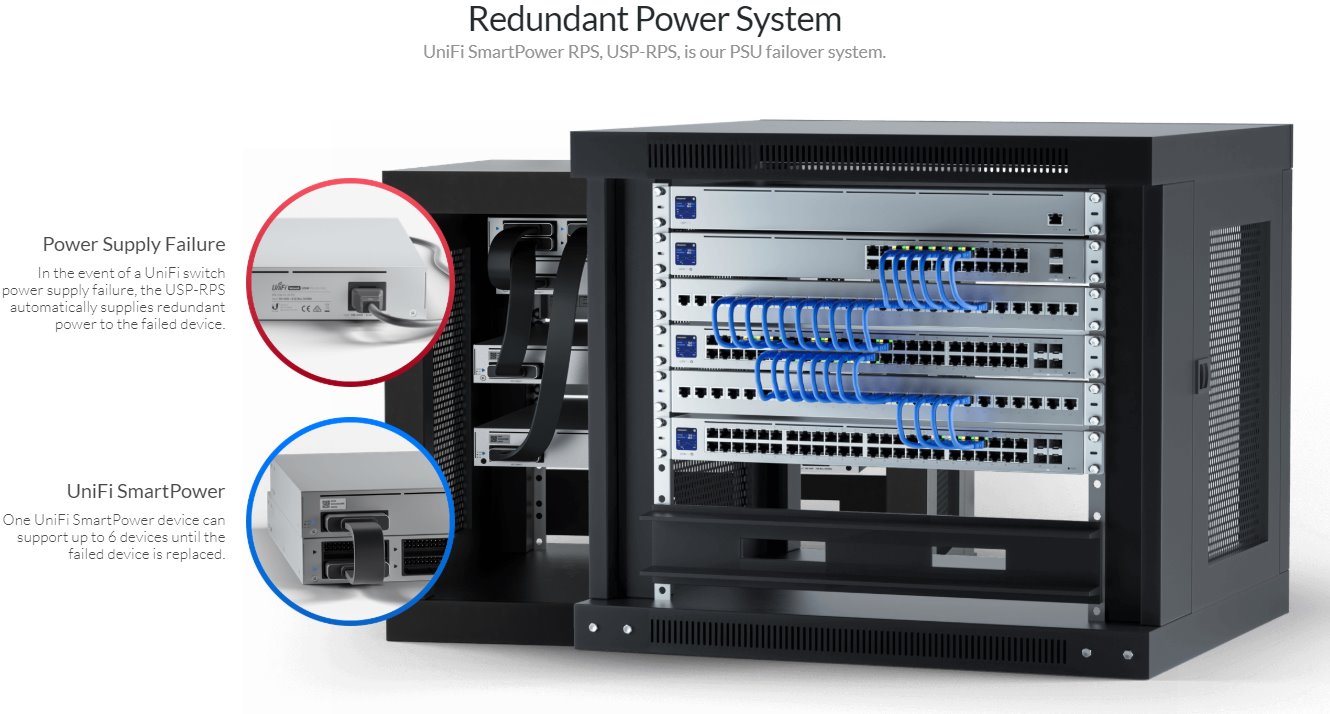
The USW-Pro-24-PoE includes support for Ubiquiti's USP-RPS redundant power system through a dedicated DC input.
The switch can therefore have:
Primary AC power
plus:
USP-RPS DC backup power
when deployed with compatible redundant-power infrastructure.
This is particularly useful for networks where switch availability is important.
Why Redundant Power Matters
Consider a switch powering:
Access points
CCTV cameras
VoIP phones
and:
access-control equipment.
If that switch loses power, all of those devices may go offline simultaneously.
Redundant power infrastructure can reduce the risk associated with a single internal or primary power-source failure.
It should still be combined with appropriate UPS and electrical design where protection against utility outages is required.
Internal 450W Power Supply
The USW-Pro-24-PoE contains an internal:
450W AC/DC power supply.
Ubiquiti specifies:
Maximum consumption excluding PoE output: 50W
and:
Maximum consumption including PoE output: 450W.
The switch accepts:
100–240V AC at 50/60Hz.
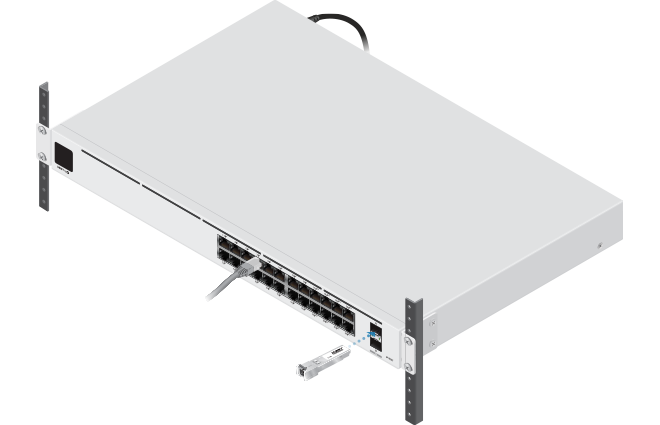
Rack-Mountable 1U Design
The switch is designed for standard:
1U rack mounting.
Its dimensions are approximately:
442 × 285 × 44mm.
Weight is approximately:
4.3kg without mounting brackets
and:
4.4kg with mounting brackets.
This makes it appropriate for network cabinets and server racks in professional installations.
Operating Environment
Ubiquiti specifies an operating temperature of:
-5°C to 40°C
and operating humidity of:
10–90% non-condensing.
The enclosure is made from SGCC steel.
The switch is designed for protected indoor rack installations rather than exposed outdoor environments.
Ubiquiti USW-Pro-24-PoE for WiFi Networks

One of the strongest applications for this switch is centralized Wi-Fi infrastructure.
For example:
Fibre / Starlink
↓
Gateway
↓
10G SFP+
↓
USW-Pro-24-PoE
├── AP – Reception
├── AP – Boardroom
├── AP – Office 1
├── AP – Office 2
├── AP – Warehouse
├── AP – Conference Room
└── Additional Network Devices
The switch can provide both Ethernet connectivity and power to compatible access points.
USW-Pro-24-PoE for UniFi WiFi 6 Access Points
The switch can be useful with compatible UniFi WiFi 6 access points such as:
U6+
U6 Pro
U6 Mesh
U6 Long-Range
and other models whose PoE requirements fall within the switch's supported standards.
Because the switch has a large 400W PoE budget, it can support considerably larger AP deployments than lower-budget switches when the overall power calculation permits.
USW-Pro-24-PoE for WiFi 7
The switch can also power compatible WiFi 7 access points whose PoE requirements fit within PoE+ or PoE++.
However, there is an important limitation:
The RJ45 ports are Gigabit, not 2.5GbE.
Ubiquiti's current specification confirms that all 24 copper ports operate at up to 1Gbps.
This matters when pairing the switch with newer APs that have 2.5GbE uplinks.
Important Limitation for U7 Pro and Other Multi-Gigabit APs
A modern access point may have:
2.5GbE Ethernet
and require:
PoE+.
The USW-Pro-24-PoE may provide sufficient electrical power but its RJ45 interface will negotiate at no more than:
1Gbps.
Therefore:
Correct PoE power does not necessarily mean maximum Ethernet performance.
For a new multi-gigabit WiFi 7 deployment, a switch with 2.5GbE PoE ports—such as an appropriate Pro Max model—may be a better choice.
USW-Pro-24-PoE for CCTV
The 400W PoE budget makes the switch particularly attractive for IP surveillance networks.
For example:
USW-Pro-24-PoE
├── Camera 1
├── Camera 2
├── Camera 3
├── Camera 4
├── Camera 5
├── Camera 6
├── Camera 7
├── Camera 8
├── Access Point 1
└── Access Point 2
The switch can centralize power and network connectivity for multiple devices.
Actual camera compatibility depends on the PoE requirement of each model.
USW-Pro-24-PoE for UniFi Protect
The switch can be incorporated into a UniFi Protect deployment containing:
UniFi cameras
UniFi Network equipment
UniFi Protect recorder/gateway
and compatible network infrastructure.
Its PoE++ ports are particularly useful for compatible high-power devices.
The switch itself does not provide Protect video recording; recording requires appropriate UniFi Protect hardware.
USW-Pro-24-PoE for VoIP
Compatible PoE VoIP phones can also be powered directly from the switch.
For example:
USW-Pro-24-PoE
├── IP Phone – Reception
├── IP Phone – Accounts
├── IP Phone – Sales
├── IP Phone – Management
└── IP Phone – Support
This eliminates individual phone power adapters where the phones support the switch's PoE standards.
USW-Pro-24-PoE for Access Control
The eight PoE++ ports make the switch relevant to compatible higher-power network devices, including some access-control applications.
A building network could combine:
Wi-Fi
CCTV
VoIP
door access
and conventional Ethernet endpoints on the same physical switch while using VLANs to logically separate their traffic.
The exact access-control equipment and power requirements should be verified before deployment.
USW-Pro-24-PoE for Hotels
Hotels can use the Pro 24 PoE to connect:
Guest-room APs
corridor APs
CCTV cameras
VoIP phones
conference equipment
access-control systems
and other Ethernet devices.
Its large PoE budget and 10G uplinks make it much better suited to high-density installations than entry-level PoE switches.
USW-Pro-24-PoE for Schools
A school network could use the switch for:
Classroom access points
administration APs
computer labs
CCTV cameras
VoIP phones
and access-control devices.
VLANs can then separate student, staff, administration, CCTV and management traffic.
USW-Pro-24-PoE for Offices
For a medium or large office:
Internet
↓
Firewall / Gateway
↓
10G SFP+
↓
USW-Pro-24-PoE
├── Access Points
├── CCTV Cameras
├── VoIP Phones
├── Workstations
├── Printers
├── Access Control
└── Servers / Other Switches
This provides a centralized managed network infrastructure.
Using USW-Pro-24-PoE with Starlink
The switch can be used downstream of Starlink.
For example:
Starlink
↓
Router / Gateway
↓
USW-Pro-24-PoE
├── UniFi AP
├── UniFi AP
├── Camera
├── Camera
└── Wired Devices
The switch does not increase Starlink's internet bandwidth.
Its main role is to distribute local Ethernet connectivity and PoE power.
Using USW-Pro-24-PoE with Fibre Internet
The switch is particularly well suited to fibre-based business networks.
A possible architecture is:
Fibre ONT
↓
Firewall / Router
↓
10G Connection
↓
USW-Pro-24-PoE
↓
Access Points + Cameras + PCs + Phones
Its 10G SFP+ uplinks can help prevent the switch uplink from becoming a bottleneck in high-traffic LAN environments.
The RJ45 access ports remain limited to 1Gbps each.
Using USW-Pro-24-PoE with MikroTik
A UniFi switch does not require a UniFi router.
You can use:
Internet
↓
MikroTik Router
↓
10G SFP+ / Gigabit Ethernet
↓
USW-Pro-24-PoE
↓
UniFi APs and Other Devices
MikroTik can handle routing and firewall functions while UniFi handles switching and wireless infrastructure.
VLANs and trunk configurations must be designed consistently across both platforms.
Using USW-Pro-24-PoE with TP-Link
The same principle applies to TP-Link routers and other upstream networking equipment.
A network can use:
TP-Link Router
↓
USW-Pro-24-PoE
↓
UniFi APs / Cameras / Other Devices
The router brand does not determine whether the switch can supply PoE to compatible downstream equipment.
USW-Pro-24-PoE vs USW-24-PoE
This is one of the most useful comparisons for buyers.
| Feature | USW-24-PoE | USW-Pro-24-PoE |
|---|---|---|
| RJ45 Ports | 24 × 1GbE | 24 × 1GbE |
| PoE+ Ports | 16 | 16 |
| PoE++ Ports | 0 | 8 |
| Total PoE Ports | 16 | 24 |
| PoE Budget | 95W | 400W |
| Uplinks | 2 × 1G SFP | 2 × 10G SFP+ |
| Switching Capacity | 52Gbps | 88Gbps |
| Non-Blocking Throughput | 26Gbps | 44Gbps |
| Forwarding Rate | 39 Mpps | 65 Mpps |
| Layer 3 | No full Pro L3 feature set | Yes |
| RPS Support | No | Yes |
| Rackmount | 1U | 1U |
The difference is substantial.
Why Choose Pro 24 PoE Instead of Standard 24 PoE?

The Standard model is suitable when you need:
basic Gigabit PoE+ switching
with moderate power requirements.
The Pro model becomes much more attractive when you need:
all 24 ports powered
PoE++
400W PoE budget
10G SFP+ uplinks
Layer 3 switching
or redundant-power capability.
For large AP and CCTV deployments, these differences can be decisive.
USW-Pro-24-PoE vs USW-Pro-24
Do not confuse:
USW-Pro-24-PoE
with:
USW-Pro-24.
The non-PoE Pro 24 has the same basic:
24 × Gigabit RJ45
2 × 10G SFP+
Layer 3
and RPS-oriented professional architecture, but it does not provide PoE output.
For APs and cameras, the PoE model is usually the more appropriate choice unless separate power infrastructure is already available.
USW-Pro-24-PoE vs Legacy US-24-250W
The older US-24-250W remains common in existing installations.
| Feature | US-24-250W | USW-Pro-24-PoE |
|---|---|---|
| RJ45 Ports | 24 × 1GbE | 24 × 1GbE |
| PoE Ports | 24 | 24 |
| Max PoE | PoE+ | PoE++ |
| PoE Budget | 250W | 400W |
| Uplinks | 2 × 1G SFP | 2 × 10G SFP+ |
| Layer 3 | No Pro L3 | Yes |
| Touchscreen | No | Yes |
| RPS | Different/legacy architecture | USP-RPS input |
The Pro model provides a substantially more modern switching platform.
USW-Pro-24-PoE vs Pro Max 24 PoE
For a completely new high-performance deployment, the newer Pro Max family is also worth considering.
The key limitation of the USW-Pro-24-PoE is:
all 24 RJ45 ports are limited to 1GbE.
The Pro Max 24 PoE adds 2.5GbE access ports while retaining high-power PoE capabilities.
Therefore:
Pro 24 PoE → strong choice for Gigabit PoE networks
while:
Pro Max 24 PoE → stronger choice for multi-gigabit WiFi 6/7 networks.
This is particularly relevant when deploying access points with 2.5GbE uplinks.
Advantages of Ubiquiti USW-Pro-24-PoE
The USW-Pro-24-PoE combines a very strong set of capabilities in a single rack-mounted switch: 24 powered Gigabit ports, eight PoE++ ports, a 400W total PoE budget, dual 10G SFP+ uplinks, Layer 3 functionality and redundant-power support.
This makes it particularly suitable for mixed networks where APs, cameras, phones and other PoE equipment all need to be powered from the same switch.
The UniFi management platform also allows the switch to integrate into a broader UniFi deployment instead of operating as an isolated network component.
Limitations of Ubiquiti USW-Pro-24-PoE
The biggest limitation for new high-performance deployments is the absence of 2.5GbE RJ45 ports. All 24 copper interfaces are limited to 1Gbps.
That is not a major problem for cameras, VoIP phones and many conventional access points, but it can restrict the wired uplink of newer multi-gigabit WiFi access points.
The switch is also considerably more powerful than many small networks need. If you only need a few PoE+ devices and do not require PoE++, Layer 3, 10G uplinks or a 400W budget, a smaller UniFi switch may be more economical.
Who Should Buy the USW-Pro-24-PoE?
The switch is particularly well suited to:
-
Medium and large offices
-
Hotels and hospitality networks
-
Schools and universities
-
CCTV and surveillance installations
-
High-density UniFi Wi-Fi networks
-
VoIP deployments
-
Access-control networks
-
Professional AV networks
-
WISPs and network integrators
-
Networks requiring 10G uplinks
-
Businesses requiring high PoE capacity
For new WiFi 7 deployments where multi-gigabit Ethernet is a priority, compare it carefully with Ubiquiti's newer multi-gigabit PoE switch options.
Ubiquiti USW-Pro-24-PoE Price
Ubiquiti's current U.S. store lists the USW-Pro-24-PoE (400W) at US$699 before the displayed surcharge, at the time checked. This is a U.S. manufacturer-store reference and not Orbitlink Solutions' Kenya selling price.
Kenya pricing can differ due to exchange rates, taxes, freight, supplier source, warranty arrangements and availability.
Contact Orbitlink Solutions for the current USW-Pro-24-PoE price and stock availability in Kenya.
Why Buy Ubiquiti USW-Pro-24-PoE from Orbitlink Solutions?

Choosing a professional PoE switch requires more than simply counting Ethernet ports. A correct design should calculate the number of powered devices, each device's maximum consumption, the required PoE class and the total PoE budget needed for the entire installation.
The USW-Pro-24-PoE is particularly strong where high PoE capacity and 10G uplinks are required but Gigabit access ports remain sufficient. Its 400W PoE budget is more than four times the 95W available on the Standard USW-24-PoE, while its eight PoE++ ports can support compatible higher-powered equipment.
Orbitlink Solutions can help match the switch with appropriate UniFi access points, cameras, SFP+ modules, DAC cables, Ethernet cabling, gateways, UPS equipment and other network components according to the required deployment.
Watch the Ubiquiti USW-Pro-24-PoE Video
The USW-Pro-24-PoE is best understood as a high-power Gigabit access switch with a fast 10G backbone. Each RJ45 endpoint is limited to 1Gbps, but the dual 10G SFP+ interfaces provide significantly greater capacity for upstream aggregation, servers or switch-to-switch links. This architecture works particularly well when many Gigabit APs, cameras, phones and other endpoints need to share a high-capacity network backbone.
Its 400W PoE budget is one of the main reasons to choose the Pro model over the Standard 24 PoE. The difference is not simply eight additional powered ports. The Pro switch supports higher-power PoE++, provides more than four times the total PoE availability, adds 10G SFP+ connectivity and introduces Layer 3 and redundant-power capabilities.
For new deployments, however, the access-port speed deserves careful consideration. The USW-Pro-24-PoE remains a powerful choice for Gigabit networks, but newer WiFi 6 and WiFi 7 installations can include APs with 2.5GbE uplinks. If maximizing multi-gigabit AP performance is part of the project, compare the Pro 24 PoE with newer UniFi Pro Max or other multi-gigabit PoE switches before purchasing.
Frequently Asked Questions About Ubiquiti USW-Pro-24-PoE
What is the Ubiquiti USW-Pro-24-PoE?
The USW-Pro-24-PoE is a 24-port Layer 3 managed UniFi switch with PoE+, PoE++, a 400W PoE budget and two 10G SFP+ uplinks.
How many Ethernet ports does USW-Pro-24-PoE have?
It has 24 Gigabit RJ45 ports.
Are all 24 ports PoE?
Yes. Sixteen provide PoE+ and eight provide PoE++.
How many PoE++ ports does it have?
It has 8 PoE++ ports.
How many PoE+ ports does it have?
It has 16 PoE+ ports.
What is the total PoE budget?
400W.
How much power can each PoE++ port provide?
Ubiquiti specifies up to 60W PSE output per PoE++ port.
Does USW-Pro-24-PoE support Gigabit Ethernet?
Yes. All 24 RJ45 interfaces support up to 1Gbps.
Does USW-Pro-24-PoE support 2.5GbE?
Not on its RJ45 access ports. They are limited to 1GbE.
Does it have 10Gbps ports?
Yes. It has two 1/10G SFP+ interfaces.
What is its switching capacity?
88Gbps.
What is its non-blocking throughput?
44Gbps.
What is its forwarding rate?
Approximately 65 Mpps.
Is USW-Pro-24-PoE Layer 3?
Yes.
Does it support inter-VLAN routing?
Yes, Ubiquiti currently lists inter-VLAN routing for local networks among its Layer 3 features.
Does it support DHCP?
It supports DHCP server functionality for local networks and DHCP relay.
Does it support VLANs?
Yes. Ubiquiti specifies support for up to 1,000 VLANs.
Does it support LACP?
Yes.
Does it support STP and RSTP?
Yes.
Does it support jumbo frames?
Yes.
Does it support port isolation?
Yes.
Does it support 802.1X?
Yes.
Does it have redundant power support?
Yes. It provides a USP-RPS DC input for compatible UniFi redundant-power infrastructure.
Does it have an internal power supply?
Yes. It has an internal 450W AC/DC power supply.
What input voltage does it accept?
100–240V AC at 50/60Hz.
Does it have a touchscreen?
Yes. It has a 1.3-inch touchscreen display.
Is it rack mountable?
Yes. It is a standard 1U rack-mount switch.
What are its dimensions?
Approximately 442 × 285 × 44mm.
How much does it weigh?
Approximately 4.3kg without rack brackets and 4.4kg with them.
Can it power UniFi access points?
Yes, provided the specific AP's PoE requirements are compatible.
Can it power U7 Pro?
Its PoE capability can support compatible PoE+ equipment such as U7 Pro, but the switch's copper ports are only 1GbE, so a multi-gigabit AP cannot obtain a 2.5GbE wired link from those ports.
Can it power IP cameras?
Yes, provided the cameras use compatible PoE standards and the total load remains within the switch's 400W budget.
Can it power VoIP phones?
Yes, for compatible PoE phones.
Can I use it with Starlink?
Yes. It can operate downstream of a Starlink gateway/router and provide Ethernet and PoE to compatible local devices.
Can I use it with a MikroTik router?
Yes. MikroTik can handle routing while the USW-Pro-24-PoE provides managed switching and PoE.
Can I use it with a TP-Link router?
Yes. The upstream router does not need to be Ubiquiti.
What is the difference between USW-24-PoE and USW-Pro-24-PoE?
The Pro provides 400W vs 95W PoE availability, 24 vs 16 powered RJ45 ports, eight PoE++ ports, dual 10G SFP+ instead of 1G SFP, Layer 3 features and redundant-power support.
What is the difference between USW-Pro-24 and USW-Pro-24-PoE?
The USW-Pro-24 does not provide PoE output, while the USW-Pro-24-PoE provides up to 400W across its PoE+/PoE++ ports.
Is USW-Pro-24-PoE good for WiFi 7?
It can provide appropriate power to compatible APs, but its RJ45 ports are limited to Gigabit. For performance-focused WiFi 7 installations, a 2.5GbE PoE switch may be preferable.
What is the Ubiquiti USW-Pro-24-PoE price in Kenya?
Contact Orbitlink Solutions for current price and stock availability.
Buy Ubiquiti USW-Pro-24-PoE in Kenya
The Ubiquiti UniFi USW-Pro-24-PoE is a powerful professional switch for networks that need substantial PoE capacity without moving every endpoint beyond Gigabit Ethernet. Its combination of 24 powered Gigabit ports, 16 PoE+ ports, eight PoE++ ports, a 400W PoE budget, Layer 3 switching and dual 10G SFP+ uplinks makes it suitable for demanding Wi-Fi, CCTV, VoIP, access-control and business networks.
For a new deployment, the main decision is whether Gigabit access ports are sufficient. Where they are, the Pro 24 PoE remains a very capable platform. Where 2.5GbE WiFi 6 or WiFi 7 access points need their full wired uplink capability, comparing it with a newer multi-gigabit UniFi PoE switch is advisable.
Contact Orbitlink Solutions
Orbitlink Solutions
Lyric House, 7th Floor, Room S9, Kimathi Street, Nairobi
Call / Text / WhatsApp: +254 743 720 551
Email: info@orbitlinksolutions.co.ke
Alternative Email: orbitlinksolutions@gmail.com
Opening Hours: Monday–Saturday, 9:00 AM–6:00 PM
Availability: Nairobi pickup and nationwide delivery
Contact Orbitlink Solutions for the current Ubiquiti USW-Pro-24-PoE price in Kenya, stock availability and assistance selecting compatible UniFi access points, SFP+ modules, DAC cables, Ethernet cabling, gateways and other networking equipment.
Need Help Choosing? Ask a Technician
Get guidance on setup, compatibility, stock, and delivery before buying for your project.