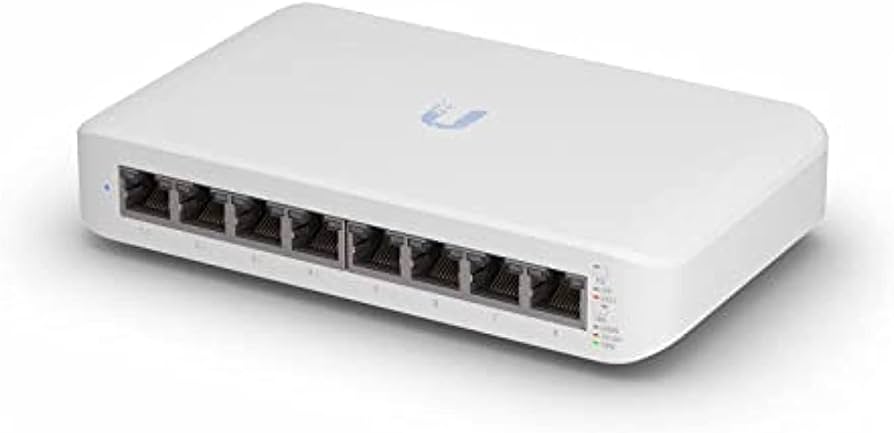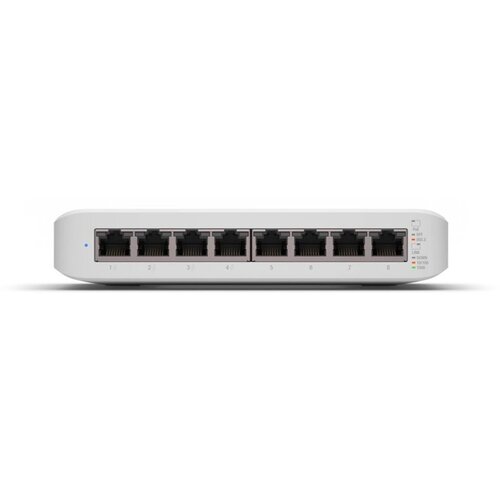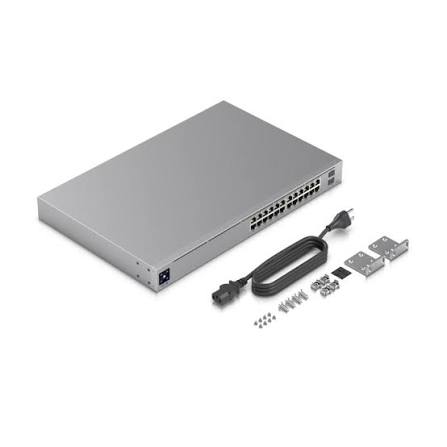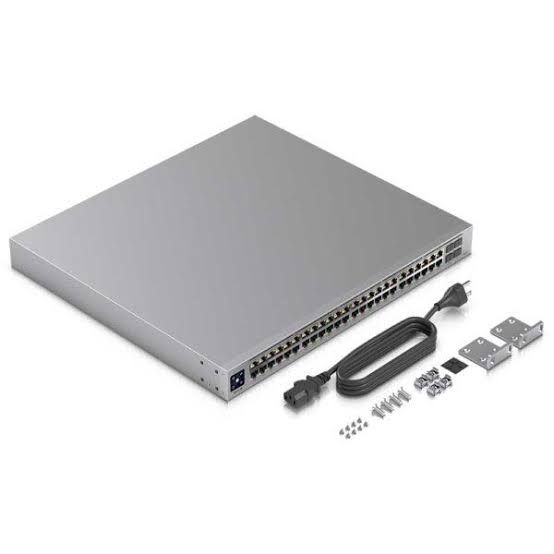
Ubiquiti USW-48-POE Switch
Buy Ubiquiti USW-48-POE in Kenya from Orbitlink Solutions. 48-port UniFi Layer 2 switch with 32 PoE+ ports, 195W PoE budget and four SFP uplinks.
Ubiquiti USW-48-POE Switch in Kenya – UniFi Standard 48 PoE Managed Switch
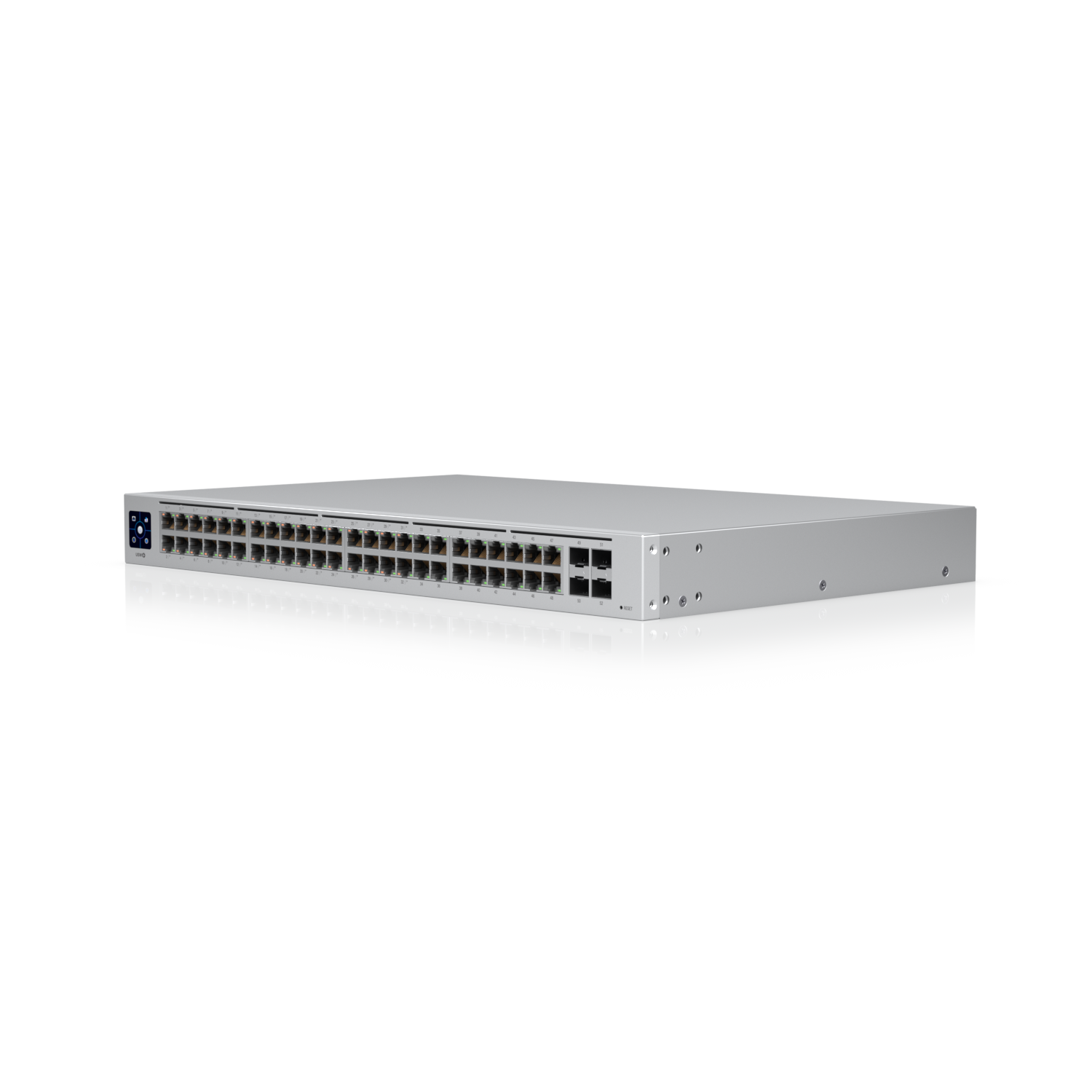
The Ubiquiti USW-48-POE, officially called the UniFi Standard 48 PoE, is a high-density managed Layer 2 switch designed for offices, schools, hotels, CCTV installations, Wi-Fi networks and other environments requiring a large number of wired Ethernet connections. It provides 48 Gigabit Ethernet ports, 32 PoE+ ports, four 1G SFP interfaces and a 195W total PoE budget.
One of the most important details is that 32 of the 48 RJ45 ports provide PoE+, while the remaining 16 are Gigabit data-only ports. This configuration makes the USW-48-POE particularly useful for mixed installations containing access points, IP cameras and VoIP phones alongside computers, printers, servers, NVRs and other non-PoE equipment.
Despite its relatively large 195W PoE capacity, Ubiquiti uses a silent, fanless cooling system in the Standard 48 PoE. This can be particularly useful in offices and other noise-sensitive installations where a conventional actively cooled 48-port PoE switch could be distracting.
Ubiquiti USW-48-POE Key Features
| Feature | Specification |
|---|---|
| Product Name | UniFi Standard 48 PoE |
| Model | USW-48-POE |
| Switch Type | Managed Layer 2 PoE Switch |
| RJ45 Ports | 48 × 10/100/1000 Mbps |
| PoE+ Ports | 32 |
| Non-PoE RJ45 Ports | 16 |
| SFP Ports | 4 × 1G |
| Maximum PoE Class | PoE+ |
| Total PoE Availability | 195W |
| Max PoE PSE Output | 15.4W PoE / 32W PoE+ per compatible port |
| Switching Capacity | 104Gbps |
| Non-Blocking Throughput | 52Gbps |
| Forwarding Rate | 77 Mpps |
| Supported VLANs | 1,000 |
| MAC Address Table | 16,000 |
| Packet Buffer | 1.5MB |
| Power Supply | Internal 240W AC/DC |
| Cooling | Fanless |
| Display | 1.3-inch touchscreen |
| Form Factor | 1U rackmount |
| Management | UniFi Network |
These specifications are from Ubiquiti's current technical documentation for the Standard 48 PoE.
48 Gigabit Ethernet Ports
The USW-48-POE provides:
48 × 10/100/1000 Mbps RJ45 Ethernet ports.
This makes it significantly better suited to high-density wired networks than a conventional 16- or 24-port switch.
A deployment could look like:
Router / Gateway
↓
USW-48-POE
├── UniFi Access Points
├── CCTV Cameras
├── VoIP Phones
├── Desktop Computers
├── Network Printers
├── Servers
├── NVR
├── Access-Control Equipment
└── Other Ethernet Devices
The switch can therefore act as the central Ethernet distribution point for a substantial office, school, hotel or surveillance installation.
32 PoE+ Ports
Of the 48 RJ45 interfaces:
32 ports provide PoE+
Ubiquiti specifies support for up to PoE+, with maximum PSE output of 15.4W for PoE and 32W for PoE+ on compatible ports.
These ports can power compatible equipment such as:
-
UniFi wireless access points
-
IP surveillance cameras
-
VoIP phones
-
access-control devices
-
network equipment
-
other IEEE PoE/PoE+ powered devices
Compatibility should always be checked against the exact powered device rather than assuming that every Ethernet device can accept PoE.
16 Non-PoE Gigabit Ports
The remaining:
16 RJ45 ports provide Gigabit Ethernet without PoE output.
This is an important distinction when planning an installation.
The USW-48-POE is correctly described as having:
48 Gigabit Ethernet ports
but only:
32 PoE+ ports.
The non-PoE ports remain useful for equipment such as:
Desktop PCs
network printers
servers
NVRs
routers
NAS devices
and other equipment with its own power source.
195W Total PoE Budget
One of the most important specifications of the USW-48-POE is its:
195W Total PoE Availability
Ubiquiti confirms this figure in both its current technical specifications and product listing.
This is substantially more than the 95W available on the Standard USW-24-POE, making the 48-port model more suitable for larger PoE deployments.
However, 195W does not mean every one of the 32 PoE+ ports can simultaneously provide maximum PoE+ power.
Understanding the PoE Budget
There are two separate limits:
Per-port PoE capability
and:
Total switch PoE budget.
A single compatible PoE+ port can provide considerably more power than an ordinary low-power camera or access point may consume.
However, all 32 powered ports share the:
195W total PoE budget.
For example, 32 ports multiplied by the switch's 32W maximum PSE figure would equal:
32 × 32W = 1,024W
but the switch cannot supply anything close to 1,024W simultaneously.
The total available PoE power remains 195W.
Example USW-48-POE Power Calculation
Consider a network containing:
| Equipment | Quantity | Maximum Power | Combined |
|---|---|---|---|
| Access Points | 8 | 13W | 104W |
| CCTV Cameras | 8 | 7W | 56W |
| VoIP Phones | 4 | 5W | 20W |
| Total | 20 devices | 180W |
The theoretical combined maximum would be:
180W
against the switch's:
195W PoE budget.
Although this fits mathematically, it leaves little headroom. For a new installation, allowing additional PoE capacity for startup behavior, device changes and future expansion is generally preferable to designing around the absolute limit.
Why PoE Budget Matters More Than PoE Port Count
A common mistake is to see:
32 PoE+ ports
and assume the switch can support any 32 PoE+ devices.
That is not necessarily true.
For example:
32 devices × 10W = 320W
which would already exceed the switch's 195W total PoE availability.
Therefore, installers should calculate:
Maximum consumption of Device 1 + Device 2 + Device 3 + ...
and compare that figure with:
195W available PoE budget.
PoE and PoE+ Support
The USW-48-POE supports standards-based PoE up to:
PoE+
Ubiquiti specifies a maximum PSE wattage of:
15.4W for PoE
and:
32W for PoE+.
This makes it appropriate for many access points, cameras and phones.
USW-48-POE Does Not Provide PoE++
The Standard 48 PoE should not be confused with Ubiquiti's Professional and higher-end PoE switches.
Its highest supported PoE output class is:
PoE+
not PoE++.
If a device specifically requires higher-power PoE++, select a compatible Professional, Pro Max or other UniFi switch that provides the required standard.
Four 1G SFP Ports
The USW-48-POE provides:
4 × 1Gbps SFP ports
in addition to its 48 Gigabit RJ45 interfaces.
These interfaces can be useful for:
fibre uplinks
connections between network cabinets
switch-to-switch links
building-to-building fibre
and other compatible SFP connections.
Having four SFP interfaces also provides greater fibre connectivity flexibility than the two SFP ports found on the Standard USW-24-POE.
Important: SFP, Not SFP+
The four fibre interfaces are:
1G SFP
and not:
10G SFP+.
This matters considerably on a 48-port switch.
A high-density deployment may have many Gigabit endpoints generating traffic simultaneously, while a single 1G uplink can become a bottleneck.
Networks requiring 10Gbps uplinks should therefore consider higher-tier UniFi switches.
104Gbps Switching Capacity
Ubiquiti specifies:
Switching Capacity: 104Gbps
Total Non-Blocking Throughput: 52Gbps
Forwarding Rate: 77 million packets per second.
These numbers describe the internal Ethernet switching performance of the device.
They do not mean the switch provides a 104Gbps internet connection.
Internet performance remains dependent on the upstream ISP, router, gateway and individual network links.
Why the Switching Capacity Is 104Gbps
The switch has:
48 × Gigabit RJ45
plus:
4 × Gigabit SFP
for a total of:
52 Gigabit interfaces.
Full-duplex switching considers traffic in both directions:
52Gbps × 2 = 104Gbps
which corresponds with Ubiquiti's published switching capacity.
This allows the switch fabric to handle substantial local traffic even though individual interfaces remain Gigabit.
Fanless and Silent Cooling
One particularly attractive feature is that Ubiquiti describes the USW-48-POE as having a:
Silent, fanless cooling system.
That is notable for a 48-port switch with a 195W PoE budget.
It makes the device useful in environments such as:
offices
meeting areas
reception spaces
small equipment rooms
and other locations where constant fan noise would be undesirable.
Fanless Does Not Mean Ventilation Is Unnecessary
A fanless switch still generates heat.
Ubiquiti specifies heat dissipation of approximately:
153.5 BTU/hr excluding PoE output.
The switch should therefore be installed in a properly ventilated rack or cabinet.
This becomes particularly important when multiple switches, routers, UPS systems, NVRs and other heat-generating equipment share the same enclosure.
Internal 240W Power Supply
The USW-48-POE uses an internal:
240W AC/DC power supply
and accepts universal:
100–240V AC, 50/60Hz input.
Ubiquiti specifies maximum consumption of:
45W excluding PoE output
and:
240W including PoE output.
The internal power supply also keeps the rack installation cleaner because a large external DC power brick is not required.
1U Rack-Mount Design
The USW-48-POE uses a standard:
1U rack-mount form factor
and measures approximately:
442 × 285 × 44 mm.
Weight is approximately:
4.5kg without mounting brackets
and:
4.6kg with mounting brackets.
Ubiquiti specifies supported rack depths of approximately:
400–1200mm.
1.3-Inch Touchscreen Display
The front panel incorporates a:
1.3-inch touchscreen LCM display.
This provides local status and identification information.
In a rack containing several UniFi switches, gateways and other devices, the front display can make equipment identification and basic inspection easier for network technicians.
Layer 2 Managed Switch
Ubiquiti positions the USW-48-POE as a:
Layer 2 PoE switch.
It is therefore intended primarily for managed Ethernet switching rather than the more extensive Layer 3 functions found on Professional-class UniFi switches.
Despite this, its current UniFi software feature set includes substantial network-management capabilities.
VLAN Support
The USW-48-POE supports up to:
1,000 VLANs
according to Ubiquiti's current specifications.
A business could therefore segment its network into areas such as:
VLAN 10 – Management
VLAN 20 – Staff
VLAN 30 – Guest Wi-Fi
VLAN 40 – CCTV
VLAN 50 – VoIP
VLAN 60 – Servers
VLAN 70 – Access Control
VLAN routing and firewall policy should then be handled according to the wider network architecture.
Advanced Layer 2 Features
Ubiquiti currently lists a broad managed feature set for the USW-48-POE, including LACP port aggregation, STP/RSTP, IGMP snooping, advanced IGMP configuration, 802.1X control, DHCP snooping and guarding, port isolation, port mirroring, jumbo frames, Voice VLAN, loop protection, storm control, flow control and several ACL/isolation capabilities.
These functions allow the switch to form part of a professionally segmented network rather than operating as a basic unmanaged 48-port switch.
LACP Port Aggregation
The USW-48-POE supports:
LACP Port Aggregation.
Compatible equipment can therefore use multiple physical links as part of an aggregated connection where the network design supports it.
However, aggregation should not be interpreted as automatically multiplying the speed of every individual client session.
Benefits depend on traffic distribution and the capabilities of both connected devices.
STP and RSTP
The switch supports:
STP
and:
RSTP.
These protocols help protect Layer 2 networks against switching loops.
This becomes increasingly important in larger deployments with several switches and redundant Ethernet paths.
IGMP Snooping
The USW-48-POE provides:
IGMP Snooping
along with advanced IGMP configuration options.
These capabilities can be useful where multicast traffic is present, including appropriately designed:
IPTV
video distribution
and other multicast applications.
802.1X Network Access Control
Ubiquiti also lists:
802.1X Control
among the supported features.
This can form part of an enterprise network-access-control architecture where connected users or devices must authenticate before receiving network access.
Appropriate authentication infrastructure is required elsewhere in the network.
Voice VLAN
The USW-48-POE supports:
Voice VLAN.
A business can therefore logically separate VoIP traffic from ordinary office traffic.
For example:
VLAN 10 – Staff Data
VLAN 20 – VoIP
VLAN 30 – Guest Wi-Fi
VLAN 40 – CCTV
This can make larger converged networks easier to manage.
UniFi Network Management
The switch is centrally managed using UniFi Network.
Ubiquiti's current specification lists UniFi Network 7.2.94 and later as the application requirement.
Administrators can use UniFi Network to work with supported:
switch ports
PoE controls
VLANs
network topology
connected clients
port profiles
traffic controls
and other configuration options.
For an active installation, use a currently supported UniFi Network release rather than deliberately installing the historical minimum version.
USW-48-POE for Large Wi-Fi Networks
The switch is particularly useful where many access points must connect back to a central network rack.
For example:
Fibre / Starlink
↓
Gateway / Router
↓
USW-48-POE
├── AP – Reception
├── AP – Ground Floor
├── AP – First Floor
├── AP – Second Floor
├── AP – Conference Area
├── AP – Warehouse
├── AP – Outdoor Area
└── Additional APs
Compatible APs can receive both data and electrical power from the switch.
USW-48-POE for UniFi Access Points
The 32 PoE+ ports make the switch suitable for powering numerous compatible UniFi access points.
However, the 195W total budget becomes the critical consideration in larger installations.
For example:
12 APs × 13W = 156W
would fit within 195W theoretically.
But:
16 APs × 13W = 208W
would exceed the total budget.
The exact maximum consumption of each AP should therefore be checked before specifying the switch.
USW-48-POE and WiFi 6
The switch can be used with compatible WiFi 6 access points that operate within its PoE+ capabilities.
For conventional WiFi 6 installations using Gigabit AP uplinks, the USW-48-POE can provide an effective centralized switching platform.
For high-density deployments, calculate the combined maximum AP consumption against the 195W PoE budget.
USW-48-POE and WiFi 7
The switch can also power compatible WiFi 7 access points that fit within its PoE+ power limits.
However, there is an important performance limitation:
Every RJ45 interface is limited to 1Gbps.
Many newer high-performance APs use multi-gigabit Ethernet interfaces.
A compatible AP may therefore receive sufficient electrical power while its Ethernet uplink is restricted to Gigabit speed.
No 2.5GbE Access Ports
The USW-48-POE provides:
48 × 1GbE RJ45
and:
4 × 1G SFP.
It does not provide 2.5GbE access ports.
For a new deployment involving numerous multi-gigabit WiFi 6 or WiFi 7 APs, consider a suitable Pro Max, Pro XG, Enterprise or other multi-gigabit UniFi switch. Ubiquiti's current switching portfolio contains several such higher-performance families.
USW-48-POE for CCTV
The combination of 32 PoE+ ports and 48 total Ethernet interfaces makes the switch particularly relevant for surveillance networks.
For example:
USW-48-POE
├── Camera 1
├── Camera 2
├── Camera 3
├── Camera 4
├── Camera 5
├── Camera 6
├── Camera 7
├── Camera 8
├── Camera 9
├── Camera 10
├── Access Point 1
├── Access Point 2
└── NVR
The NVR can use a non-PoE data port while compatible cameras receive data and power from PoE+ ports.
USW-48-POE for UniFi Protect
The switch can form part of a larger UniFi Protect network by supplying Ethernet and PoE to compatible UniFi cameras.
A deployment could include:
UniFi Gateway / Protect Recorder
↓
USW-48-POE
├── Protect Cameras
├── UniFi Access Points
├── VoIP Equipment
└── Wired Network Devices
The switch itself does not record video. Appropriate UniFi Protect recording hardware is still required.
USW-48-POE for VoIP Phones

Compatible VoIP phones can receive both power and Ethernet connectivity from the switch.
This is particularly useful in larger offices and call-centre environments where deploying individual power adapters for dozens of desk phones would create unnecessary complexity.
A UPS supporting the network rack can also provide centralized backup power to the switch and therefore to connected PoE phones, subject to UPS sizing.
USW-48-POE for Offices
A medium or large office might use:
Fibre Internet
↓
Router / Firewall
↓
USW-48-POE
├── Access Points
├── CCTV Cameras
├── VoIP Phones
├── Desktop PCs
├── Printers
├── NVR
├── NAS
└── Other Ethernet Equipment
The mixture of 32 PoE+ and 16 non-PoE ports is particularly practical for this type of environment.
USW-48-POE for Hotels
Hotels can require large numbers of network endpoints, including:
guest-room APs
corridor APs
lobby Wi-Fi
CCTV cameras
VoIP phones
reception computers
conference equipment
and access-control systems.
The USW-48-POE's 48 ports provide useful density, although the 195W PoE budget must be calculated carefully where many devices require power.
USW-48-POE for Schools and Universities
Educational institutions can use the switch for:
classroom access points
computer labs
CCTV cameras
administrative offices
VoIP phones
printers
and other wired network devices.
VLANs can then separate:
Students
Staff
Administration
Guest Wi-Fi
CCTV
and Management traffic.
Using USW-48-POE with Starlink
The switch can be deployed downstream of a Starlink connection.
For example:
Starlink
↓
Router / Gateway
↓
USW-48-POE
├── UniFi APs
├── CCTV Cameras
├── VoIP Phones
└── Wired Devices
The USW-48-POE distributes local Ethernet connectivity and PoE power.
It does not increase the internet bandwidth supplied by Starlink.
Using USW-48-POE with Fibre Internet
The switch can also operate behind virtually any correctly configured fibre gateway/router.
For example:
Fibre ONT
↓
Firewall / Router
↓
USW-48-POE
↓
APs + Cameras + Phones + Computers
Because the switch's interfaces are Gigabit, individual Ethernet and SFP links are limited to 1Gbps.
For multi-gigabit fibre deployments, this limitation should be considered before purchasing.
Using USW-48-POE with MikroTik
A Ubiquiti switch does not require a Ubiquiti router.
A network can use:
Internet
↓
MikroTik Router
↓
USW-48-POE
↓
UniFi APs / Cameras / Other Devices
MikroTik can perform routing, firewall and WAN functions while UniFi handles managed switching and wireless infrastructure.
VLANs and trunks should be configured consistently across both platforms.
Using USW-48-POE with TP-Link
Similarly:
TP-Link Router
↓
USW-48-POE
↓
UniFi APs / Cameras / Other Devices
can operate correctly when configured appropriately.
The upstream router's brand does not determine whether the Ubiquiti switch can power compatible downstream PoE equipment.
USW-48-POE vs USW-48
The non-PoE USW-48 is another Standard-series option.
The major difference is straightforward:
USW-48 → no PoE output
USW-48-POE → 32 PoE+ ports and 195W PoE budget.
Both belong to Ubiquiti's current Standard switching family.
For a network containing many APs or cameras, the PoE version eliminates the need for individual injectors or a separate PoE switch.
USW-48-POE vs USW-24-POE
| Feature | USW-24-POE | USW-48-POE |
|---|---|---|
| RJ45 Ports | 24 | 48 |
| PoE+ Ports | 16 | 32 |
| Non-PoE RJ45 | 8 | 16 |
| PoE Budget | 95W | 195W |
| SFP Ports | 2 × 1G | 4 × 1G |
| Switching Capacity | 52Gbps | 104Gbps |
| Non-Blocking Throughput | 26Gbps | 52Gbps |
| Forwarding Rate | 39 Mpps | 77 Mpps |
| Cooling | Fanless | Fanless |
| Layer | Layer 2 | Layer 2 |
Ubiquiti currently lists both models within its Standard family, with the 48 PoE effectively providing approximately double the port density and roughly double the available PoE power of the Standard 24 PoE.
USW-48-POE vs USW-Pro-48-POE
The Standard 48 PoE and Pro 48 PoE target different network requirements.
The Standard model is designed around:
Gigabit access
PoE+
195W total PoE
1G SFP uplinks
and Layer 2 switching.
The Professional family provides higher-end capabilities and is more appropriate where requirements include higher PoE classes, faster uplinks or more advanced switching functionality. Ubiquiti continues to list both Standard and Professional 48-port models in its current portfolio.
USW-48-POE vs Legacy US-48-500W
Do not confuse the current:
USW-48-POE
with the older:
US-48-500W.
Ubiquiti now lists the latter separately as:
Standard 48 PoE (Gen1).
Legacy Gen1 high-power switches can have substantially different PoE budgets, power modes, cooling designs and hardware characteristics.
The exact model number should therefore be checked when replacing or expanding an older installation.
Advantages of the Ubiquiti USW-48-POE
The strongest advantage of the USW-48-POE is port density. Forty-eight Gigabit Ethernet interfaces allow one 1U switch to support a large number of network endpoints, while 32 of those interfaces can directly power compatible PoE+ equipment.
Its 195W PoE budget provides considerably more power than the Standard 24 PoE, making it better suited to installations containing numerous access points, cameras or phones. The four SFP interfaces also provide additional fibre connectivity options for larger networks.
The fanless design is another important advantage. Ubiquiti specifically markets the switch as a silent, fanless 48-port Layer 2 PoE switch, which is unusual enough to be particularly valuable in noise-sensitive office installations.
Limitations of the Ubiquiti USW-48-POE
The first limitation is that only 32 of the 48 RJ45 ports provide PoE. Buyers who require power on all 48 ports need to consider another switch or additional PoE infrastructure.
The second limitation is the 195W total PoE budget. While substantial, it can still be exhausted by a high-density deployment containing many higher-consumption APs, cameras or other PoE devices.
The third limitation is interface speed. The switch has Gigabit RJ45 and 1G SFP connectivity only. There are no 2.5GbE access ports or 10G SFP+ uplinks, making higher-tier UniFi switches more suitable for performance-focused multi-gigabit networks.
Who Should Buy the USW-48-POE?
The USW-48-POE is particularly suitable for medium and larger conventional Gigabit networks where many Ethernet connections are required but the deployment does not need 2.5GbE access ports, 10G uplinks or PoE++.
It can be a practical fit for offices, schools, hotels, retail environments, surveillance networks, multi-AP Wi-Fi installations, VoIP deployments and other networks requiring a mixture of PoE and ordinary Ethernet ports.
For a new high-performance WiFi 7 network or a deployment requiring substantially more than 195W of PoE, compare it with Ubiquiti's Professional, Pro Max, Pro XG or Enterprise switching options before selecting the final switch.
Ubiquiti USW-48-POE Price
For reference, Ubiquiti's U.S. store currently lists the Standard 48 PoE USW-48-POE (195W) at US$589 before the separately displayed surcharge. This is a manufacturer U.S.-store reference, not Orbitlink Solutions' Kenya price.
Kenya pricing can differ because of exchange rates, shipping, taxes, supplier source, warranty arrangements and stock availability.
Contact Orbitlink Solutions for the current Ubiquiti USW-48-POE price and stock availability in Kenya.
Why Buy Ubiquiti USW-48-POE from Orbitlink Solutions?

The USW-48-POE is best selected after calculating both port requirements and PoE consumption. A project may need fewer than 32 powered ports yet still exceed 195W if the individual devices consume substantial power. Conversely, a network with many low-power cameras and phones may fit comfortably within the available budget.
Uplink requirements should also be considered before purchase. Four SFP interfaces provide useful fibre connectivity, but they remain limited to 1Gbps. If the switch will aggregate substantial traffic from dozens of endpoints, the overall backbone design should be evaluated rather than considering the switch in isolation.
Orbitlink Solutions can help match the USW-48-POE with suitable UniFi access points, cameras, routers, gateways, SFP modules, fibre accessories, Ethernet cabling and related networking equipment according to the deployment requirements.
Watch the Ubiquiti USW-48-POE Video
The USW-48-POE is essentially a high-density Standard-series UniFi switch. Its 48 Gigabit ports make it particularly attractive where rack space matters and a business wants to consolidate many Ethernet connections into a single 1U device. With 32 PoE+ interfaces, it can simultaneously handle powered and non-powered endpoints without requiring a separate access switch for ordinary wired equipment.
Its 195W PoE budget is the specification that deserves the most attention during network design. Thirty-two PoE+ ports provide plenty of physical connection capacity, but they do not create 32 independent full-power budgets. Every powered device draws from the same 195W pool. The correct design therefore begins by adding the published maximum consumption of all APs, cameras, phones and other powered devices.
The other important consideration is the network's future speed requirement. The USW-48-POE is an excellent fit for conventional Gigabit infrastructure, but its access and fibre interfaces remain 1Gbps. If a new project is expected to move toward 2.5GbE access points, 10G switch uplinks or higher-power PoE++, choosing a more advanced UniFi switch at the beginning may provide greater expansion capacity.
Frequently Asked Questions About Ubiquiti USW-48-POE
What is the Ubiquiti USW-48-POE?
The USW-48-POE, officially Standard 48 PoE, is a 48-port managed Layer 2 UniFi switch with 32 PoE+ ports, four 1G SFP ports and a 195W total PoE budget.
How many Ethernet ports does USW-48-POE have?
It has 48 Gigabit RJ45 ports.
Are all 48 ports PoE?
No. 32 ports provide PoE+, while 16 RJ45 ports provide Gigabit Ethernet without PoE.
How many PoE ports does USW-48-POE have?
It has 32 PoE+ ports.
What is the total PoE budget?
The switch provides 195W total PoE availability.
Does USW-48-POE support PoE+?
Yes. Its maximum PoE output class is PoE+.
Does USW-48-POE support PoE++?
No. The current Standard 48 PoE is specified up to PoE+.
What is the maximum PoE output per port?
Ubiquiti lists 15.4W PSE for PoE and up to 32W PSE for PoE+. The 195W total switch budget still applies.
Does USW-48-POE have Gigabit Ethernet?
Yes. All 48 RJ45 interfaces support up to Gigabit Ethernet.
Does it support 2.5GbE?
No. Its RJ45 ports are 1GbE.
How many SFP ports does it have?
It provides four 1G SFP interfaces.
Does it have SFP+?
No. These are 1G SFP rather than 10G SFP+ interfaces.
What is its switching capacity?
104Gbps.
What is its non-blocking throughput?
52Gbps.
What is its forwarding rate?
Approximately 77 Mpps.
Is USW-48-POE Layer 3?
Ubiquiti positions this model as a Layer 2 switch.
Does it support VLANs?
Yes. Ubiquiti currently specifies support for up to 1,000 VLANs.
Does it support LACP?
Yes.
Does it support STP and RSTP?
Yes.
Does it support IGMP Snooping?
Yes.
Does it support 802.1X?
Yes.
Does it support port isolation?
Yes.
Does it support Voice VLAN?
Yes.
Does it support jumbo frames?
Yes.
Is USW-48-POE fanless?
Yes. Ubiquiti describes it as having a silent, fanless cooling system.
Is the USW-48-POE rack mountable?
Yes. It is a 1U rack-mount switch.
What are its dimensions?
Approximately 442 × 285 × 44mm.
How much does it weigh?
Approximately 4.5kg without mounting brackets and 4.6kg with them.
What power supply does it use?
It has an internal 240W AC/DC power supply and accepts 100–240V AC at 50/60Hz.
Does it have a touchscreen?
Yes. It includes a 1.3-inch touchscreen display.
Can USW-48-POE power UniFi access points?
Yes, provided the exact AP is compatible with its PoE/PoE+ output and the combined powered-device load remains within 195W.
Can it power WiFi 6 access points?
Yes, for compatible models within its PoE+ and total-power limits.
Can it power WiFi 7 access points?
It can power compatible WiFi 7 models within its PoE+ limits, but the RJ45 link is limited to 1Gbps.
Can USW-48-POE power CCTV cameras?
Yes, for compatible PoE/PoE+ cameras within the 195W total budget.
Can it power VoIP phones?
Yes, for compatible PoE phones.
Can I use USW-48-POE with Starlink?
Yes. It can operate downstream of Starlink or another router/gateway. It distributes LAN connectivity and PoE but does not increase Starlink's internet bandwidth.
Can I use USW-48-POE with MikroTik?
Yes. MikroTik can handle routing and firewall functions while the USW-48-POE provides managed Ethernet switching and PoE.
Can I use it with TP-Link?
Yes. The upstream router does not have to be Ubiquiti.
What is the difference between USW-48 and USW-48-POE?
The USW-48 is the non-PoE Standard 48 model, while USW-48-POE provides 32 PoE+ ports and 195W total PoE availability.
What is the difference between USW-24-POE and USW-48-POE?
USW-24-POE has 24 RJ45 ports, 16 PoE+ ports, 95W PoE and two SFP ports. USW-48-POE increases this to 48 RJ45, 32 PoE+, 195W PoE and four SFP interfaces.
Is USW-48-POE suitable for a large CCTV installation?
It can be, but calculate the maximum consumption of all cameras and other powered devices. The physical 32-PoE-port capacity does not override the 195W total power limit.
What is the Ubiquiti USW-48-POE price in Kenya?
Contact Orbitlink Solutions for the current price and stock availability.
Buy Ubiquiti USW-48-POE in Kenya
The Ubiquiti UniFi USW-48-POE is a practical high-density switch for organizations that need a large number of conventional Gigabit connections combined with substantial PoE capability. Its 48 Gigabit RJ45 ports, 32 PoE+ interfaces, 195W PoE budget, four 1G SFP ports, 104Gbps switching capacity and fanless 1U design make it particularly suitable for offices, schools, hotels, CCTV networks and larger Wi-Fi deployments.
The main purchasing decision should revolve around PoE budget and future network speed. If 195W of PoE and Gigabit connectivity are sufficient, the USW-48-POE offers considerable port density. If the project requires PoE++, 2.5GbE access ports or 10G uplinks, Ubiquiti's Professional and higher-end switch families provide more appropriate alternatives.
Contact Orbitlink Solutions
Orbitlink Solutions
Lyric House, 7th Floor, Room S9, Kimathi Street, Nairobi
Call / Text / WhatsApp: +254 743 720 551
Email: info@orbitlinksolutions.co.ke
Alternative Email: orbitlinksolutions@gmail.com
Opening Hours: Monday–Saturday, 9:00 AM–6:00 PM
Availability: Nairobi pickup and nationwide delivery
Contact Orbitlink Solutions for the current Ubiquiti USW-48-POE price in Kenya, stock availability and assistance selecting compatible UniFi access points, cameras, SFP modules, Ethernet cabling, gateways and other networking equipment.
Need Help Choosing? Ask a Technician
Get guidance on setup, compatibility, stock, and delivery before buying for your project.