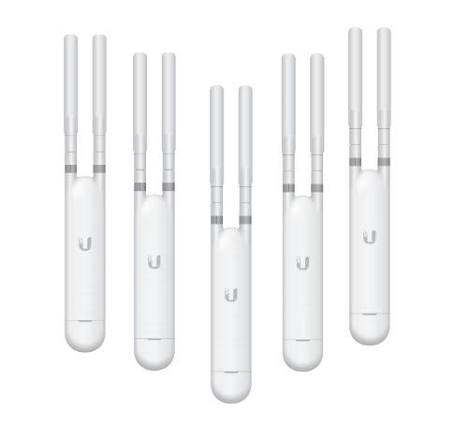
Ubiquiti UAP-AC-M AC Mesh
Buy Ubiquiti UAP-AC-M AC Mesh in Kenya from Orbitlink Solutions. Dual-band WiFi 5 outdoor AP with mesh, Gigabit Ethernet, PoE and external antennas.
Ubiquiti UniFi UAP-AC-M / AC Mesh Access Point in Kenya

The Ubiquiti UniFi UAP-AC-M, officially called the UniFi AC Mesh, is a compact indoor/outdoor WiFi 5 access point designed for flexible wireless coverage in homes, offices, hotels, restaurants, schools, warehouses, compounds, gardens and other locations. Ubiquiti's current specifications rate it for four spatial streams, approximately 140m² coverage and 200+ clients.
The UAP-AC-M uses simultaneous 2.4GHz and 5GHz 2×2 MIMO radios. It provides theoretical PHY rates of up to 300Mbps on 2.4GHz and 867Mbps on 5GHz, together with a Gigabit Ethernet uplink and PoE power.
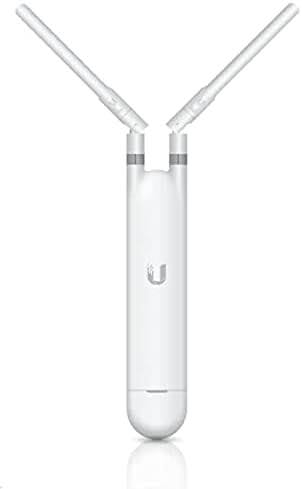
One of its most useful features is the external antenna system. The AP ships with two detachable dual-band omnidirectional antennas and can use compatible external antennas through its RP-SMA connections. Ubiquiti's older official datasheet also documents compatibility with optional connectorized antennas for customized coverage patterns.
Ubiquiti UAP-AC-M Key Features
| Feature | Specification |
|---|---|
| Product | UniFi AC Mesh |
| Model | UAP-AC-M |
| Wi-Fi Standard | WiFi 5 |
| Bands | 2.4GHz + 5GHz |
| Spatial Streams | 4 |
| 5GHz MIMO | 2×2 DL MU-MIMO |
| 2.4GHz MIMO | 2×2 DL MU-MIMO |
| 5GHz Max PHY Rate | 867Mbps at 80MHz |
| 2.4GHz Max PHY Rate | 300Mbps at 40MHz |
| Ethernet | 1 × Gigabit RJ45 |
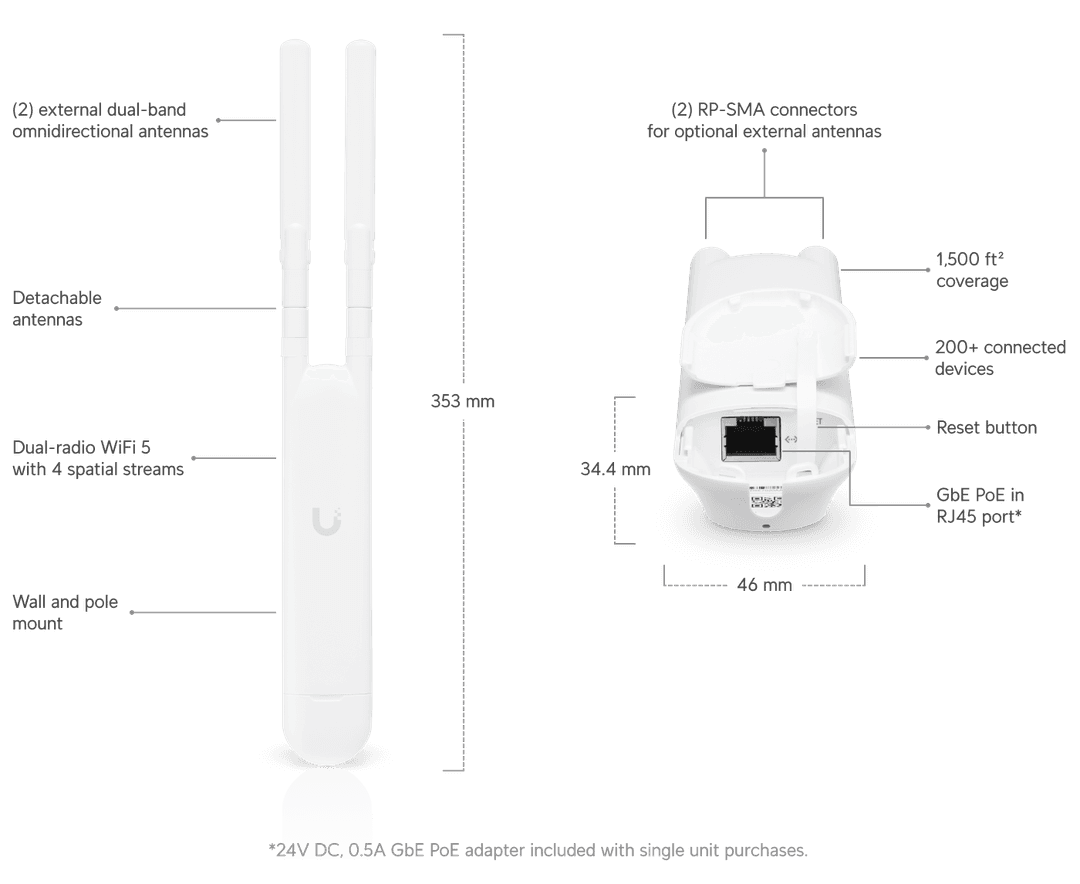
| Coverage Rating | 140m² / 1,500ft² |
| Maximum Client Rating | 200+ |
| 5GHz Antenna Gain | 4dBi |
| 2.4GHz Antenna Gain | 3dBi |
| Maximum TX Power | 20dBm per radio |
| Maximum BSSIDs | 8 per radio |
| Power Method | PoE |
| Maximum Power Consumption | 8.5W |
| Weatherproofing | IPX4 |
| Mounting | Wall / Pole |
| Dimensions | 353 × 46 × 34.4mm |
| Weight | 152g |
| Management | Ethernet / Bluetooth |
| Best For | Flexible indoor/outdoor Wi-Fi and mesh deployments |
These specifications reflect Ubiquiti's current technical page rather than older marketing figures that may appear in legacy documentation.
Dual-Band WiFi 5
The UAP-AC-M is a WiFi 5 access point operating simultaneously on:
2.4GHz
and
5GHz.
The two bands can serve different types of clients. The 2.4GHz band is useful for longer-range and legacy connections, while 5GHz generally offers better throughput and more spectrum for compatible devices.
The AP does not support WiFi 6, WiFi 7 or 6GHz. For a new installation requiring newer wireless standards, Ubiquiti's current WiFi 6 and WiFi 7 portfolio should also be considered.
Four Spatial Streams
The UAP-AC-M provides four total spatial streams.
Its radio architecture consists of:
2×2 on 5GHz
plus
2×2 on 2.4GHz.
This differs from the larger UAP-AC-M-PRO, which uses 3×3 radios and provides six spatial streams.
The standard AC Mesh is therefore positioned as the smaller and more compact member of the two older UniFi AC Mesh models.
867Mbps 5GHz Wi-Fi
The 5GHz radio supports a maximum theoretical PHY rate of:
867Mbps at 80MHz channel width.
Supported VHT channel widths include:
20MHz, 40MHz and 80MHz.
The 867Mbps figure is not guaranteed internet throughput. Real performance will be lower and depends on signal quality, interference, channel width, client capabilities, network congestion and upstream internet capacity.
300Mbps 2.4GHz Wi-Fi
The 2.4GHz radio provides a maximum theoretical PHY rate of:
300Mbps at 40MHz.
2.4GHz can be useful for:
-
IoT devices
-
POS terminals
-
Printers
-
Older laptops
-
Smartphones
-
Handheld devices
-
Clients requiring better propagation
In congested locations, using narrower 20MHz channels can often provide better overall channel reuse than using 40MHz.
External Dual-Band Antennas
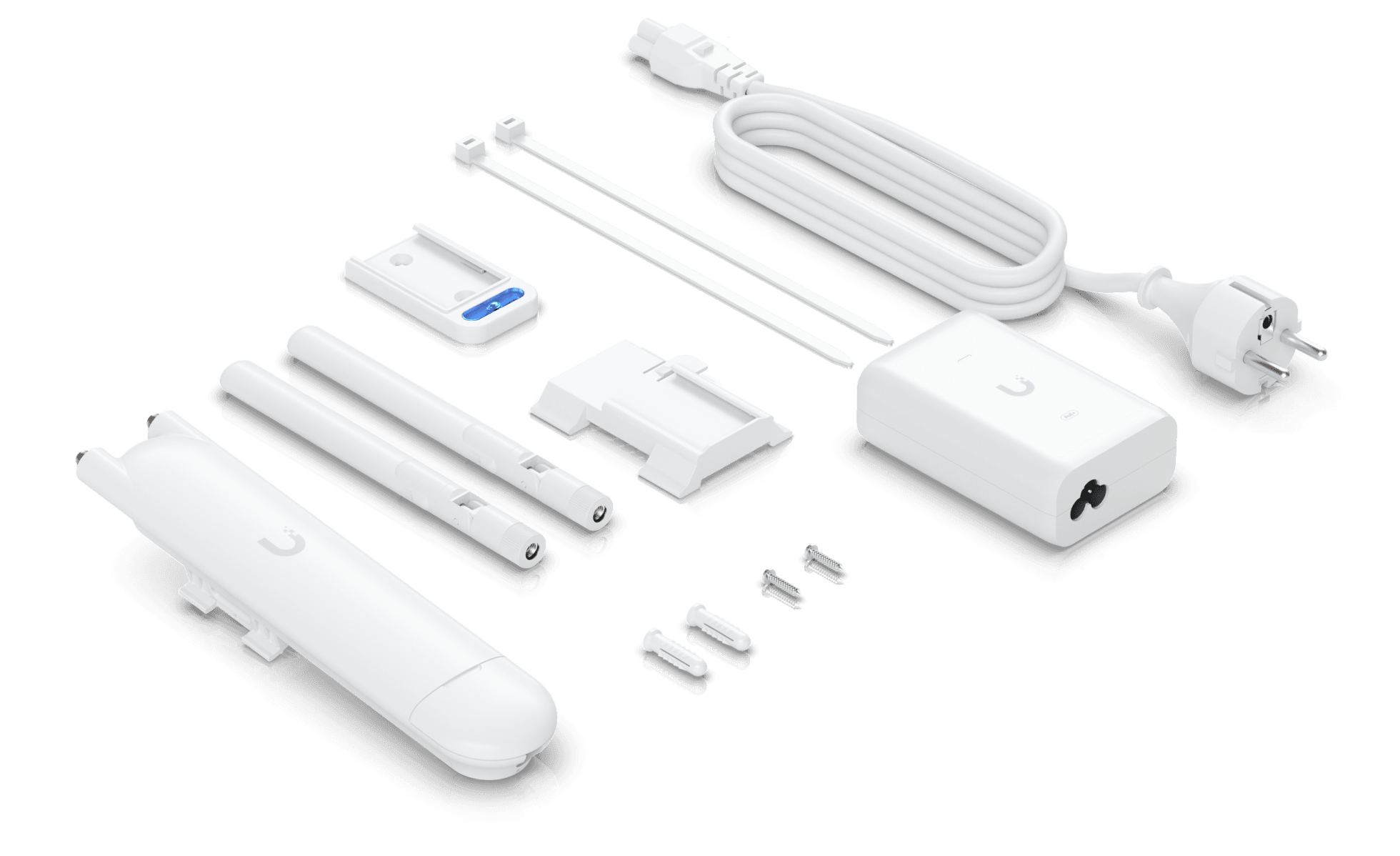
A major difference between the UAP-AC-M and many conventional ceiling access points is its two detachable external antennas.
Ubiquiti specifies standard antenna gain at:
3dBi on 2.4GHz
and
4dBi on 5GHz.
The antennas can be positioned according to the mounting arrangement, making the device particularly convenient for wall and pole installations.
RP-SMA External Antenna Support
The UAP-AC-M provides two RP-SMA antenna connections, giving installers more flexibility than APs with permanently integrated antennas. Ubiquiti's official documentation states that the supplied omnidirectional antennas can be replaced with compatible connectorized antennas for expanded coverage and customized pattern shaping.
This can be particularly useful when a project requires more directional wireless coverage.
External antennas should still be selected and configured according to local radio regulations, because permitted transmit power and antenna gain vary by regulatory domain.
Ubiquiti UMA-D Directional Antenna
The Ubiquiti UMA-D is a directional dual-band antenna designed for compatible AC Mesh installations. It uses two RP-SMA connections and provides published gains of 10dBi on 2.4GHz and 15dBi on 5GHz.
Its published horizontal beamwidth is approximately 90° at 2.4GHz and 45° at 5GHz, allowing coverage to be concentrated toward a specific area rather than distributed broadly around the AP.
A UAP-AC-M with an appropriate directional antenna can therefore be useful for targeted coverage of courtyards, outdoor seating areas, sections of a compound or other defined zones.
Gigabit Ethernet
The UAP-AC-M includes:
1 × Gigabit Ethernet RJ45 port.
A conventional wired installation can therefore use:
Internet
↓
Router / Gateway
↓
Gigabit PoE Switch
↓
UAP-AC-M
↓
Wireless Clients
Gigabit Ethernet provides adequate wired capacity for the AP's WiFi 5 radio architecture.
PoE Power
The UAP-AC-M receives power through its Ethernet connection.
Ubiquiti's current specifications list:
PoE
with a supported voltage range of:
44–57V DC.
Older official Ubiquiti documentation additionally documents compatibility with 802.3af PoE Alternative A and 24V passive PoE, which is relevant when integrating older installations and injectors.
Because power arrangements can differ across older UniFi hardware and deployments, installers should verify the exact PoE source rather than assuming every PoE injector or switch is interchangeable.
Important PoE Compatibility Note
Ubiquiti's official installation documentation specifically states that the UAP-AC-M supports 802.3af PoE and 24V passive PoE, but does not support 802.3af Mode B in the documented configuration.
This means installers should confirm the:
PoE standard → voltage → wiring method → AP compatibility
before connecting the device.
This is particularly important when reusing older passive-PoE equipment.
Low 8.5W Maximum Power Consumption
The UAP-AC-M has a maximum published power consumption of only:
8.5W.
For planning purposes:
4 APs × 8.5W = 34W
8 APs × 8.5W = 68W
10 APs × 8.5W = 85W
A PoE switch should still have additional headroom and account for every other powered device on the network.
Indoor and Outdoor Installation
The UAP-AC-M is intended for indoor and outdoor applications. Ubiquiti's current specification gives it an IPX4 weatherproofing rating.
IPX4 means the device has protection against splashing water under the relevant test conditions. It should not be interpreted as complete waterproofing.
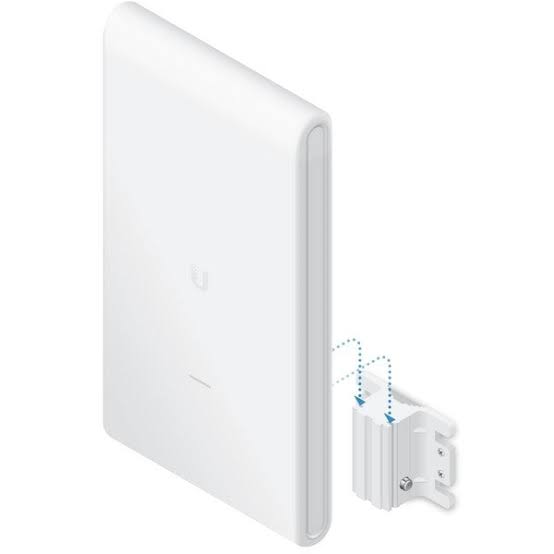
Outdoor installation should therefore still consider mounting position, water ingress around cabling, outdoor-rated Ethernet, surge protection and exposure to severe weather.
Wall Mounting
The AC Mesh supports wall mounting, and Ubiquiti includes the required mount.
This configuration can work well for:
Offices
Restaurants
Hotel common areas
Warehouses
Homes
Outdoor terraces
Building exteriors
Correct antenna orientation is important for achieving the intended coverage pattern.
Pole Mounting
The UAP-AC-M also supports pole mounting.
Ubiquiti specifies compatible pole diameters of approximately:
25–76mm / 1–3 inches.
Pole installation can be useful around:
Compounds
Schools
Hotels
Gardens
Parking areas
Warehouses
Outdoor commercial areas
Wireless Meshing
Wireless meshing is one of the UAP-AC-M's core capabilities.
A mesh deployment can look like:
Router
↓
PoE Switch
↓
Wired UniFi AP
↓
Wireless Mesh Link
↓
UAP-AC-M
↓
Wireless Clients
This can help extend coverage into areas where installing an Ethernet data cable is difficult.
Wired Backhaul vs Wireless Mesh
Although the product is called AC Mesh, wireless meshing does not mean mesh should automatically be used for every installation.
Wired Backhaul
PoE Switch → Ethernet → UAP-AC-M
This is generally preferable because it provides more predictable capacity and does not consume wireless airtime for backhaul.
Wireless Mesh
Wired UniFi AP → Wireless Backhaul → UAP-AC-M
This is useful where running Ethernet is impractical.
The mesh AP still requires power, and the quality of its connection depends on the wireless link to the upstream AP.
Band Steering
The UAP-AC-M supports band steering.
This can help encourage compatible dual-band clients toward 5GHz when appropriate.
2.4GHz can then remain available for devices that need its greater propagation or lack 5GHz support.
Band steering assists the process, but the client device still plays an important role in band selection.
Fast Roaming
Ubiquiti's current software feature set for the AC Mesh includes:
802.11k Radio Resource Management
802.11v BSS Transition Management
802.11r Fast Roaming.
These technologies can help compatible clients transition between multiple UniFi APs.
For example:
Reception AP
↓
Office AP
↓
Restaurant AP
↓
Outdoor AC Mesh
can form part of the same centrally managed wireless environment.
Guest Wi-Fi and Captive Portal
The UAP-AC-M supports UniFi captive portal capabilities including custom landing pages, voucher authentication, payment-based authentication, external portal servers, password authentication and guest-network isolation.
This makes it useful for hospitality and public-access applications such as:
Hotels
Restaurants
Cafés
Schools
Guest houses
Commercial facilities
Guest traffic can be separated from business networks using appropriate VLAN and firewall configuration.
Private Pre-Shared Keys
The current UniFi feature set supports Private Pre-Shared Keys (PPSK) on the AC Mesh.
PPSK can allow different groups or users to authenticate using different passwords while connecting through the same SSID.
This can simplify access management in shared commercial environments.
Dynamic RADIUS VLAN Assignment
The AC Mesh also supports:
Dynamic RADIUS-assigned VLANs
and
RADIUS over TLS / RadSec.
This is useful for professional networks where a user's authentication credentials determine which network or VLAN they are assigned to.
Client Isolation
Ubiquiti lists both:
Guest network isolation
and
client-device isolation
among the current AC Mesh features.
These controls can be valuable on public Wi-Fi networks where individual users should not be able to communicate directly with other wireless clients.
Wi-Fi Speed Limiting
The UAP-AC-M supports Wi-Fi speed limiting through the UniFi platform.
For example, an organization could configure:
Staff Wi-Fi → Higher allocation
Guest Wi-Fi → Restricted allocation
This helps protect business-critical applications from excessive guest traffic.
140m² Coverage Rating
Ubiquiti currently rates the AC Mesh for approximately:
140m²
or
1,500ft² of coverage.
This is a manufacturer planning figure rather than a guarantee.
Actual coverage depends on factors such as building materials, mounting height, interference, antenna orientation, trees, walls, metal structures and the capabilities of the connected client devices.
Long Range Does Not Mean Unlimited Range
The AC Mesh can be used outdoors and with specialized external antennas, but Wi-Fi remains a two-way radio connection.
The access point must hear the client just as the client must hear the access point.
Adding a high-gain antenna can change the coverage pattern and link budget, but it cannot automatically compensate for a weak smartphone or other low-power client.
For large properties, multiple properly positioned APs may therefore provide a better user experience than trying to cover everything from one AP.
200+ Client Rating
Ubiquiti's current specification rates the UAP-AC-M for:
200+ clients.
This is an association-capacity figure, not a guarantee that 200 users can simultaneously stream high-bandwidth content at maximum speed.
Practical capacity depends heavily on airtime utilization, application requirements, signal quality, interference and available internet bandwidth.
UAP-AC-M for Hotels
Hotels can use AC Mesh access points around:
Gardens
Pool areas
Outdoor restaurants
Walkways
Courtyards
Guest common areas
Parking surroundings
The AP can be managed alongside compatible indoor UniFi access points through the same UniFi Network environment.
UAP-AC-M for Restaurants
Restaurants can use the AC Mesh to extend Wi-Fi into:
Outdoor seating
Terraces
Gardens
Entrances
Waiting areas
Separate wireless networks can then be configured for staff, POS equipment and guests.
UAP-AC-M for Schools
Possible applications include:
Courtyards
Walkways
Outdoor learning areas
Administration surroundings
Staff areas
School compounds
Large campuses may require several APs rather than a single AC Mesh.
UAP-AC-M for Warehouses
The UAP-AC-M can support wireless devices such as:
Barcode scanners
Tablets
Inventory terminals
Smartphones
IoT equipment
Warehouses can be challenging RF environments because metal shelving, machinery and stored products may significantly affect wireless propagation.
A proper site survey is particularly useful for these installations.
UAP-AC-M for Compounds and Outdoor Areas

The AC Mesh is well suited to general outdoor coverage around:
Residential compounds
Commercial compounds
Gardens
Parking areas
Outdoor offices
Hospitality spaces
Its pole mounting and external antenna options provide useful installation flexibility.
For large open areas requiring much greater capacity or newer Wi-Fi technology, modern UniFi outdoor APs should also be evaluated.
UAP-AC-M for Starlink
The UAP-AC-M can be used to extend a Starlink connection across a property.
A typical installation could be:
Starlink
↓
Router / Gateway
↓
Gigabit PoE Switch
↓
UAP-AC-M
↓
Wi-Fi Clients
The AC Mesh improves the local wireless network.
It does not increase the bandwidth delivered by the Starlink connection itself.
UAP-AC-M for Fibre Internet
The AP also works behind conventional fibre routers and gateways.
For example:
Fibre ONT
↓
Router / Firewall
↓
Gigabit PoE Switch
↓
UAP-AC-M
↓
Wireless Clients
Its Gigabit Ethernet interface is well matched to its AC-class radio platform.
UAP-AC-M vs UAP-AC-M-PRO
| Feature | UAP-AC-M | UAP-AC-M-PRO |
|---|---|---|
| Wi-Fi Standard | WiFi 5 | WiFi 5 |
| Spatial Streams | 4 | 6 |
| 5GHz MIMO | 2×2 | 3×3 |
| 2.4GHz MIMO | 2×2 | 3×3 |
| 5GHz PHY | 867Mbps | 1.3Gbps |
| 2.4GHz PHY | 300Mbps | 450Mbps |
| Coverage | 140m² | 185m² |
| Clients | 200+ | 250+ |
| Ethernet | 1 × GbE | 2 × GbE |
| Antenna Gain | 3/4dBi | 8dBi |
| External Antennas | Yes | No |
| Maximum Power | 8.5W | 9W |
| Weatherproofing | IPX4 | IPX4 |
Ubiquiti's current specifications clearly position the Mesh Pro as the higher-capacity model, while the standard AC Mesh is smaller and provides external antenna flexibility.
UAP-AC-M vs U7 Mesh
The modern U7 Mesh represents a much newer approach to the same general compact mesh/outdoor AP concept.
| Feature | UAP-AC-M | U7 Mesh |
|---|---|---|
| Wi-Fi Generation | WiFi 5 | WiFi 7 |
| Spatial Streams | 4 | 4 |
| 5GHz MIMO | 2×2 | 2×2 |
| 5GHz Max PHY | 867Mbps | 4.3Gbps |
| 2.4GHz Max PHY | 300Mbps | 688Mbps |
| Ethernet | 1GbE | 2.5GbE |
| Coverage | 140m² | 140m² |
| Clients | 200+ | 200+ |
| Weatherproofing | IPX4 | IPX6 with outdoor mount |
The U7 Mesh provides a significantly newer radio platform, 2.5GbE and stronger weather protection when installed with its outdoor mount.
The UAP-AC-M can still make sense for an existing UniFi AC deployment, a cost-conscious installation or a project that specifically benefits from its RP-SMA external antenna connections.
UAP-AC-M vs Swiss Army Knife Ultra
The Swiss Army Knife Ultra (UK-Ultra) is another current UniFi WiFi 5 option. Ubiquiti rates it for 115m² coverage, 200+ clients, Gigabit Ethernet and IPX6 weatherproofing, with a 2×2 radio architecture.
The UAP-AC-M provides a larger current manufacturer coverage figure of 140m² and has a long-established external antenna ecosystem.
The UK-Ultra, however, offers newer physical design options and a stronger IPX6 weatherproofing rating.
Advantages of Ubiquiti UAP-AC-M
The UAP-AC-M is particularly attractive because it combines compact size, indoor/outdoor deployment, dual-band WiFi 5, external antennas, Gigabit Ethernet, PoE, wireless meshing and centralized UniFi management. Its current UniFi software feature set also includes fast roaming, band steering, PPSK, captive portal functionality, client isolation and dynamic RADIUS VLAN assignment.
Its RP-SMA connections are especially useful for specialized projects because they allow compatible antennas to change the AP's coverage characteristics. Ubiquiti's official documentation specifically describes the use of connectorized antennas for expanded coverage and customized pattern shaping.
For established UniFi networks, the AC Mesh can therefore remain a useful solution even though newer WiFi 6 and WiFi 7 alternatives now exist.
Limitations of Ubiquiti UAP-AC-M
The main limitation is its age. It is a WiFi 5 access point and therefore lacks newer WiFi 6 and WiFi 7 technologies. Its 5GHz radio is limited to 2×2 MIMO and an 867Mbps theoretical PHY rate, while its Ethernet interface is limited to Gigabit.
It also carries an IPX4 weatherproofing rating rather than the stronger IPX6 rating found on some newer outdoor UniFi products. Outdoor installations therefore still require careful placement, cabling and environmental protection.
For a completely new high-performance installation, it is sensible to compare the AC Mesh with current WiFi 6 and WiFi 7 UniFi options before purchasing.
Who Should Buy the UAP-AC-M?
The UAP-AC-M is particularly suitable for existing UniFi installations, outdoor Wi-Fi extensions, hotels, restaurants, schools, warehouses, compounds, large homes and projects requiring external antenna flexibility.
It is also useful where the available internet connection and client requirements do not justify the additional cost of newer multi-gigabit WiFi 7 infrastructure.
For new high-density or high-throughput deployments, newer UniFi models should be evaluated alongside it.
Typical UAP-AC-M Installation
A conventional wired installation can use:
Fibre / Starlink
↓
Router or Gateway
↓
Gigabit PoE Switch
↓
Cat6 Ethernet
↓
UAP-AC-M
↓
2.4GHz + 5GHz Clients
For a larger site, several APs can be distributed throughout the property and centrally managed through UniFi Network.
Ubiquiti UAP-AC-M Price in Kenya
The exact selling price in Kenya can vary according to stock source, exchange rates, warranty, taxes and supplier.
Rather than treating international manufacturer pricing or third-party Kenya listings as the Orbitlink selling price:
Contact Orbitlink Solutions for the current Ubiquiti UAP-AC-M price and stock availability in Kenya.
The total project cost may also need to include the PoE switch or injector, structured cabling, surge protection, router or gateway and professional installation.
Why Buy Ubiquiti UAP-AC-M from Orbitlink Solutions?
Choosing the correct access point involves more than comparing headline wireless speeds. The UAP-AC-M is particularly useful where the requirement includes outdoor deployment, wall or pole mounting, wireless meshing and flexible external antennas. Its 140m² and 200+ client figures should be treated as manufacturer planning ratings rather than guaranteed performance in every environment.
The supporting network should also be designed correctly. A wired Ethernet backhaul should normally be preferred when possible, while wireless mesh is useful when data cabling is impractical. Outdoor installations may additionally require suitable Ethernet cable, surge protection and careful mounting.
Orbitlink Solutions can help match the UAP-AC-M with compatible routers, PoE switches, injectors, Ethernet cabling and other UniFi access points according to the site's coverage requirements.
Watch the Ubiquiti UAP-AC-M / AC Mesh Video
The AC Mesh's biggest advantage is deployment flexibility rather than raw wireless speed. Its compact body, wall and pole mounting, outdoor-capable design, wireless mesh support and detachable antennas allow it to solve coverage requirements that may be awkward for a conventional indoor ceiling AP. Ubiquiti continues to include the UAP-AC-M in its current UniFi WiFi portfolio.
Its external antenna architecture is particularly important. Installers can use the included omnidirectional antennas for general coverage or compatible connectorized antennas where a more specialized radiation pattern is required. Ubiquiti's official AC Mesh documentation specifically highlights this flexibility.
At the same time, buyers should recognize that the UAP-AC-M belongs to the WiFi 5 generation. Its 867Mbps and 300Mbps radio figures are theoretical PHY rates, and newer UniFi WiFi 6 and WiFi 7 products offer substantially greater wireless capacity. The AC Mesh therefore makes the most sense when its specific outdoor, mesh, antenna and cost characteristics align with the project.
Frequently Asked Questions About Ubiquiti UAP-AC-M
Is UAP-AC-M the same as UniFi AC Mesh?
Yes. UAP-AC-M is the model number for the Ubiquiti UniFi AC Mesh.
Is UAP-AC-M WiFi 5?
Yes. Ubiquiti currently classifies it as WiFi 5.
Is it dual-band?
Yes. It operates on 2.4GHz and 5GHz.
Does UAP-AC-M support WiFi 6?
No. It is a WiFi 5 AP.
Does it support WiFi 7?
No.
Does it have 6GHz?
No.
What is the maximum 5GHz rate?
Ubiquiti specifies up to 867Mbps theoretical PHY rate at 80MHz.
What is the maximum 2.4GHz rate?
Up to 300Mbps theoretical PHY rate at 40MHz.
How many spatial streams does it have?
Four total: two on 5GHz and two on 2.4GHz.
Does UAP-AC-M have Gigabit Ethernet?
Yes. It has one GbE RJ45 port.
Does UAP-AC-M support PoE?
Yes. Ubiquiti's current specifications list PoE, while its official legacy documentation also describes 802.3af Alternative A and 24V passive PoE support.
How much power does it consume?
Maximum rated consumption is 8.5W.
Is UAP-AC-M suitable for outdoor use?
Yes. Ubiquiti lists wall/pole mounting and IPX4 weatherproofing.
Is UAP-AC-M waterproof?
It has an IPX4 rating. That should not be interpreted as complete waterproofing.
Can UAP-AC-M be wall mounted?
Yes.
Can it be pole mounted?
Yes. Ubiquiti specifies support for approximately 25–76mm poles.
Can the antennas be replaced?
Yes. The AC Mesh supports compatible external antennas through its antenna connections.
Can I use a directional antenna?
Yes, provided the antenna is compatible and the installation complies with applicable radio regulations. The Ubiquiti UMA-D is one directional option with dual RP-SMA connections.
Does UAP-AC-M support mesh?
Yes. Wireless meshing is supported.
Is wired Ethernet better than wireless mesh?
Generally yes when cabling is practical. Wired backhaul avoids consuming wireless airtime for the mesh link.
Does UAP-AC-M support fast roaming?
Yes. Ubiquiti currently lists 802.11k, 802.11v and 802.11r.
Does it support guest Wi-Fi?
Yes. Captive portal and guest isolation features are supported.
Does it support PPSK?
Yes.
Does it support RADIUS VLAN assignment?
Yes. Dynamic RADIUS-assigned VLAN and RadSec are listed among the current features.
How much area does UAP-AC-M cover?
Ubiquiti's current manufacturer planning figure is approximately 140m² / 1,500ft².
How many clients does it support?
Ubiquiti currently rates it for 200+ clients.
Is UAP-AC-M better than UAP-AC-M-PRO?
The Mesh Pro has higher radio capacity, larger manufacturer-rated coverage and two Gigabit interfaces. The standard AC Mesh is smaller and offers detachable external antennas.
Can UAP-AC-M work with MikroTik routers?
Yes. It can operate behind a MikroTik router when Ethernet, DHCP, VLAN and firewall settings are configured correctly.
Can it work with TP-Link switches?
Yes, provided the switch supplies compatible Ethernet and PoE. The exact PoE implementation should be verified before connecting power.
Can UAP-AC-M work with Starlink?
Yes. It can distribute a Starlink internet connection across the local wireless network.
Does it increase Starlink speed?
No. It can improve Wi-Fi distribution but cannot increase the internet bandwidth supplied by Starlink.
Is UAP-AC-M still worth buying?
It can still make sense for existing UniFi networks, outdoor Wi-Fi extensions, cost-conscious deployments and installations needing external antenna flexibility. For a completely new high-performance network, compare newer WiFi 6 and WiFi 7 options as well.
What is the Ubiquiti UAP-AC-M price in Kenya?
Contact Orbitlink Solutions for the current exact-model price and stock availability.
Buy Ubiquiti UAP-AC-M AC Mesh in Kenya
/product/80/3044491/2.jpg?8246)
The Ubiquiti UniFi UAP-AC-M AC Mesh remains a versatile option for projects requiring dual-band WiFi 5, Gigabit Ethernet, PoE, wireless meshing, outdoor deployment and flexible external antennas. Ubiquiti's current specifications rate it for 140m² coverage and 200+ clients.
For an existing UniFi network or an outdoor deployment where replaceable antennas are valuable, the UAP-AC-M can still be a practical choice. For new networks prioritizing maximum wireless performance, multi-gigabit Ethernet or newer client technology, compare it with Ubiquiti's current WiFi 6 and WiFi 7 models.
Contact Orbitlink Solutions
Orbitlink Solutions
Lyric House, 7th Floor, Room S9, Kimathi Street, Nairobi
Call / Text / WhatsApp: +254 743 720 551
Email: info@orbitlinksolutions.co.ke
Alternative Email: orbitlinksolutions@gmail.com
Opening Hours: Monday–Saturday, 9:00 AM–6:00 PM
Availability: Nairobi pickup and nationwide delivery
Contact Orbitlink Solutions for the current Ubiquiti UAP-AC-M price in Kenya, stock availability, compatible PoE equipment, external antennas, structured cabling, UniFi configuration and professional Wi-Fi installation.
Need Help Choosing? Ask a Technician
Get guidance on setup, compatibility, stock, and delivery before buying for your project.